



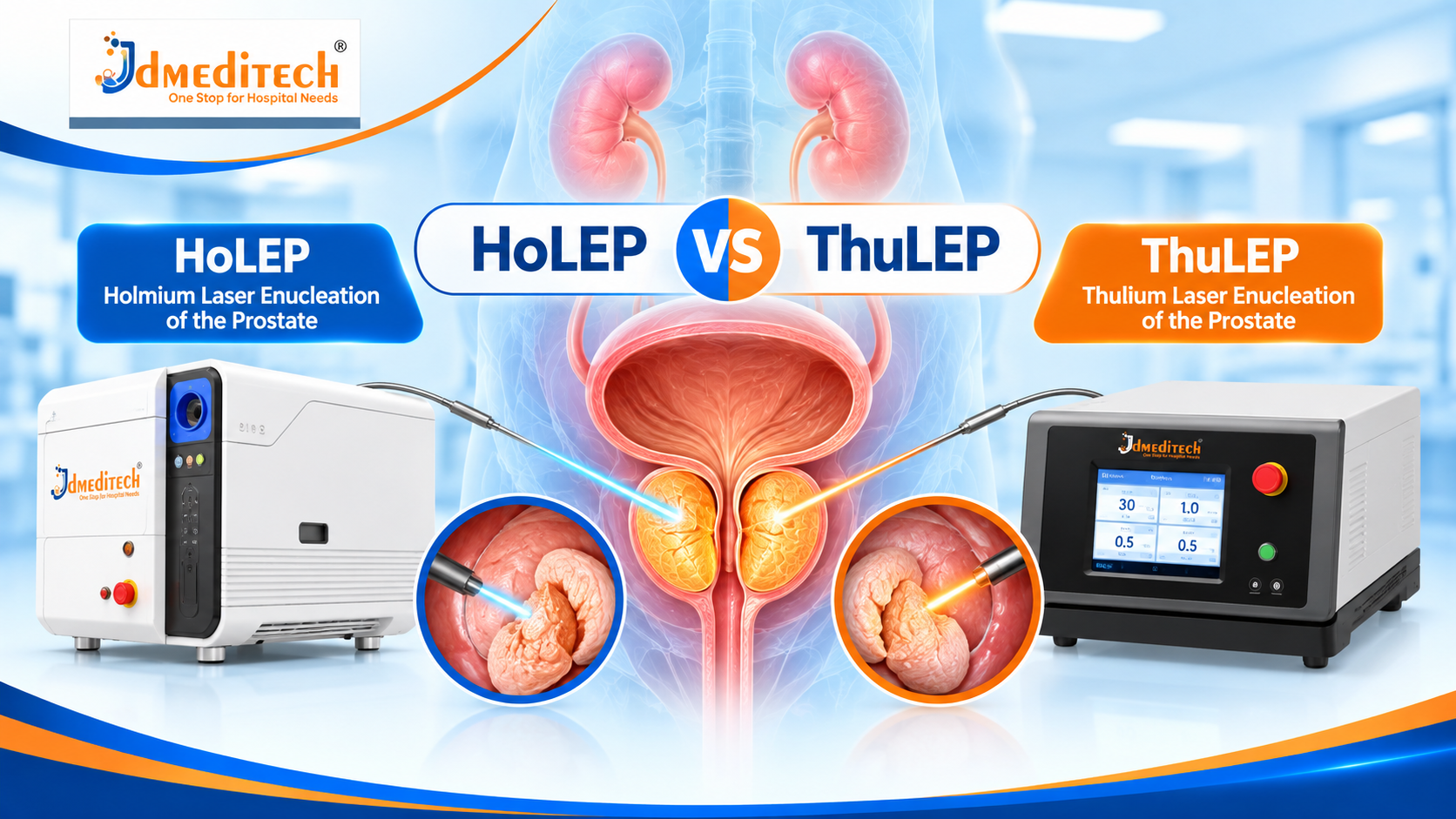
In this article, we compare HoLEP vs ThuLEP, including their laser technology, working principles, similarities, differences, and important selection factors.
What Is Laser Enucleation of the Prostate?
Laser enucleation of the prostate is an endoscopic surgical technique used in the management of benign prostatic obstruction. During the procedure, the surgeon separates obstructing prostate tissue from the surgical capsule using an appropriate laser system.
After enucleation, the separated tissue is generally moved into the bladder. Next, a tissue morcellation system can remove the enucleated tissue according to the selected surgical technique.
Several laser technologies can support prostate enucleation. However, holmium and thulium lasers are among the technologies used for this purpose. As a result, HoLEP and ThuLEP have become important terms in modern endoscopic urology.
What Is HoLEP?
HoLEP stands for Holmium Laser Enucleation of the Prostate. It is an endoscopic technique that uses holmium laser energy to support the enucleation of obstructing prostate tissue.
The Ho:YAG laser commonly operates at a wavelength of approximately 2,140 nm. Its laser energy interacts strongly with water-containing tissue. Therefore, surgeons can use the technology for controlled tissue cutting, dissection, and coagulation during appropriate urological procedures.
HoLEP has an established role in the surgical management of benign prostatic obstruction. However, successful outcomes depend on several factors, including appropriate patient selection, surgeon experience, equipment, and clinical technique.
Key Features of HoLEP
- Uses holmium laser technology
- Ho:YAG wavelength is approximately 2,140 nm
- Uses an endoscopic approach
- Supports prostate tissue enucleation
- Can provide cutting and coagulation effects
- Usually involves tissue morcellation after enucleation
- Requires appropriate equipment and surgical training
How Does HoLEP Work?
First, the surgeon introduces appropriate endoscopic instruments through the urethra. Therefore, the procedure does not require a conventional external surgical incision for access to the prostate.
Next, the surgeon identifies the appropriate anatomical plane and uses holmium laser energy to separate the obstructing prostate tissue from the surgical capsule.
The surgeon then moves the enucleated tissue into the bladder. Subsequently, a compatible morcellation system can divide and remove the tissue according to the surgical technique.
Finally, the surgeon evaluates the operative area and completes the procedure according to the patient’s condition and established clinical protocol.
What Is ThuLEP?
ThuLEP stands for Thulium Laser Enucleation of the Prostate. Like HoLEP, it is an endoscopic technique used to enucleate obstructing prostate tissue. However, ThuLEP uses thulium laser technology instead of a holmium laser.
Thulium laser systems can differ depending on their design and laser source. For example, Tm:YAG systems operate at wavelengths around 2,010 nm. Different thulium technologies may also deliver laser energy differently.
Therefore, buyers and healthcare professionals should review the specifications of the particular laser platform rather than assuming that every thulium system has identical technical characteristics.
Key Features of ThuLEP
- Uses thulium laser technology
- Supports endoscopic prostate enucleation
- Offers tissue cutting and coagulation capabilities
- Different thulium platforms may use different energy-delivery modes
- Usually requires tissue removal after enucleation
- Requires appropriate endoscopic equipment
- Requires trained healthcare professionals
How Does ThuLEP Work?
The general surgical principle of ThuLEP is similar to prostate enucleation with other laser technologies. First, the surgeon introduces the required endoscopic instruments through the urethra.
Next, the surgeon uses thulium laser energy to identify and develop the appropriate tissue plane. The surgeon then separates the obstructing prostate tissue from the surgical capsule.
After enucleation, the surgeon generally moves the separated tissue into the bladder. Subsequently, a compatible tissue morcellator can remove the tissue according to the selected surgical technique.
Therefore, the main difference between HoLEP and ThuLEP is not simply the basic concept of enucleation. Instead, an important distinction is the type and characteristics of the laser technology.
HoLEP vs ThuLEP: Key Differences
The HoLEP vs ThuLEP comparison mainly involves the laser source and its technical characteristics. HoLEP uses holmium laser technology, whereas ThuLEP uses thulium laser technology.
However, both techniques aim to achieve endoscopic enucleation of obstructing prostate tissue. Therefore, healthcare professionals should consider the complete clinical situation rather than selecting a procedure based only on the laser name.
| Feature | HoLEP | ThuLEP |
|---|---|---|
| Full Form | Holmium Laser Enucleation of the Prostate | Thulium Laser Enucleation of the Prostate |
| Laser Technology | Holmium | Thulium |
| Typical Laser Type | Ho:YAG | Depends on thulium laser platform |
| Typical Wavelength | Approximately 2,140 nm | Approximately 2,010 nm for Tm:YAG systems |
| Approach | Endoscopic | Endoscopic |
| Main Principle | Prostate tissue enucleation | Prostate tissue enucleation |
| Tissue Removal | Generally followed by morcellation | Generally followed by morcellation |
| Selection | Depends on clinical requirements and available expertise | Depends on clinical requirements and available expertise |
Holmium Laser vs Thulium Laser Technology
Laser technology represents one of the most important differences between HoLEP and ThuLEP. Both laser types operate in wavelengths that interact strongly with water-containing biological tissue. However, their technical characteristics are different.
Ho:YAG laser systems typically operate at approximately 2,140 nm. In comparison, Tm:YAG laser systems operate at approximately 2,010 nm. Moreover, different laser platforms can use different methods of energy delivery.
These technical differences can influence laser-tissue interaction, cutting characteristics, coagulation, equipment configuration, and the surgeon’s handling technique.
However, laser wavelength alone does not determine the clinical result. Instead, outcomes also depend on patient factors, surgical technique, equipment, and surgeon experience.
Similarities Between HoLEP and ThuLEP
Although HoLEP and ThuLEP use different laser technologies, they also share several important characteristics.
First, both techniques use an endoscopic approach through the urethra. In addition, both procedures aim to separate obstructing prostate tissue along an appropriate anatomical plane.
Furthermore, both techniques may involve moving the enucleated tissue into the bladder before removing it with an appropriate tissue morcellation system.
Therefore, the fundamental surgical concept is similar even though the laser source differs.
HoLEP vs ThuLEP: Clinical Outcomes
Clinical studies have compared HoLEP and ThuLEP for the surgical management of benign prostatic obstruction. Overall, evidence suggests that both techniques can provide effective functional outcomes when appropriately performed.
Studies have evaluated factors such as urinary symptom improvement, urinary flow, operative characteristics, hospital stay, catheterization, and complications. However, individual results can vary according to patient characteristics, surgical technique, laser platform, and surgeon experience.
Therefore, it is not appropriate to claim that one technique provides better results for every patient. Instead, clinicians should evaluate each patient individually.
Advantages of HoLEP
HoLEP is a well-established laser enucleation technique with extensive clinical experience. In addition, many urologists and healthcare facilities have adopted holmium laser technology for different endoscopic urological applications.
The technique provides controlled laser-assisted tissue dissection and coagulation. Moreover, the same type of laser technology can support other appropriate urological procedures depending on the laser system and accessories.
However, equipment availability and surgeon training remain important considerations.
Advantages of ThuLEP
ThuLEP provides another laser-based approach to prostate enucleation. Thulium laser technology offers effective tissue interaction and coagulation characteristics for appropriate procedures.
In addition, different thulium platforms may provide specific energy-delivery characteristics. Therefore, surgeons can evaluate the technical properties of a particular laser platform according to their procedural requirements.
However, the benefits of a specific system should always be evaluated using its technical specifications and clinical evidence.
HoLEP vs ThuLEP: Which Is Better?
There is no universal answer to whether HoLEP or ThuLEP is better. Both techniques can provide effective surgical management of benign prostatic obstruction when appropriately performed.
For example, one healthcare facility may have extensive experience with HoLEP and established holmium laser equipment. In contrast, another facility may use a thulium laser platform and have surgeons trained in ThuLEP.
Therefore, the choice can depend on patient requirements, surgeon expertise, available laser technology, equipment, procedural preferences, and institutional protocols.
Most importantly, healthcare professionals should base treatment decisions on clinical assessment rather than marketing claims about a particular laser technology.
Factors to Consider When Selecting a Laser System
Healthcare facilities should evaluate several factors before selecting a laser platform for prostate surgery. First, they should consider the intended clinical applications. Next, they should review the technical specifications of the laser system.
Important considerations may include:
- Laser type and wavelength
- Power output
- Energy-delivery mode
- Compatible laser fibers
- Endoscopic compatibility
- Tissue cutting characteristics
- Coagulation characteristics
- Surgeon training and experience
- Equipment availability
- Maintenance and technical support
- Applicable regulatory requirements
- Manufacturer’s Instructions for Use
Consequently, hospitals should evaluate the complete laser platform instead of comparing systems only by maximum power or wavelength.
Role of the Laser Fiber in Prostate Enucleation
The laser fiber transfers laser energy from the laser generator to the operative area. Therefore, fiber compatibility is an important part of the complete system.
Different laser systems may require specific fibers, connectors, dimensions, and operating parameters. As a result, healthcare professionals should use only compatible accessories according to the laser manufacturer’s instructions.
Moreover, appropriate fiber handling and system setup can contribute to consistent procedural performance.
Role of Morcellation After Prostate Enucleation
After the surgeon enucleates the obstructing prostate tissue, the tissue generally requires removal from the bladder. Therefore, tissue morcellation is an important part of many prostate enucleation procedures.
A morcellator mechanically divides the enucleated tissue into smaller pieces for removal. However, clinicians must use the device according to appropriate visualization, surgical technique, and manufacturer instructions.
Consequently, the complete setup for laser prostate enucleation may include a laser generator, compatible laser fiber, endoscopic instruments, irrigation equipment, and tissue morcellation equipment.
JDMeditech Urology Solutions
JDMeditech provides medical devices, instruments, and equipment solutions for urology and endourology. Our product portfolio supports hospitals, urologists, healthcare facilities, medical distributors, and international medical-device buyers.
In addition, customers can contact JDMeditech to discuss available urology laser systems, endoscopic instruments, laser fibers, accessories, and other equipment according to their requirements.
For additional product information, visit the JDMeditech website or contact our team for specifications, available configurations, quantities, and quotation requirements.
Frequently Asked Questions About HoLEP and ThuLEP
What does HoLEP stand for?
HoLEP stands for Holmium Laser Enucleation of the Prostate. It uses holmium laser technology to support endoscopic prostate tissue enucleation.
What does ThuLEP stand for?
ThuLEP stands for Thulium Laser Enucleation of the Prostate. It uses thulium laser technology for endoscopic prostate tissue enucleation.
What is the main difference between HoLEP and ThuLEP?
The main difference is the laser technology. HoLEP uses a holmium laser, while ThuLEP uses a thulium laser. Therefore, the systems have different laser characteristics even though both procedures use the principle of prostate enucleation.
What wavelength does HoLEP use?
Ho:YAG laser systems used for HoLEP typically operate at approximately 2,140 nm.
What wavelength does ThuLEP use?
The wavelength depends on the specific thulium laser technology. For example, Tm:YAG systems operate at approximately 2,010 nm. Therefore, users should check the specifications of the individual laser platform.
Is HoLEP better than ThuLEP?
Not necessarily. Both techniques can provide effective clinical outcomes. Therefore, healthcare professionals should consider the patient, surgeon experience, available equipment, clinical evidence, and institutional protocols.
Does HoLEP require tissue morcellation?
After prostate tissue is enucleated and moved into the bladder, a tissue morcellation system is commonly used to remove the tissue. However, the exact technique depends on the procedure and equipment.
Can the same laser machine perform HoLEP and ThuLEP?
Not automatically. HoLEP and ThuLEP use different laser technologies. Therefore, healthcare facilities should check the specifications, intended use, compatible accessories, and regulatory status of the particular laser system.
Conclusion
Overall, the HoLEP vs ThuLEP comparison highlights two important laser-based approaches to endoscopic prostate enucleation. HoLEP uses holmium laser technology, whereas ThuLEP uses thulium laser technology.
Although their laser characteristics differ, both techniques follow the general principle of removing obstructing prostate tissue through endoscopic enucleation. Moreover, both can provide effective outcomes when appropriately performed.
Therefore, the selection between HoLEP and ThuLEP should consider the patient’s clinical requirements, surgeon expertise, laser platform, available equipment, clinical evidence, and institutional protocols.
Finally, hospitals and medical distributors looking for urology laser equipment and related solutions can contact JDMeditech for available product specifications, configurations, and quotation details.
Disclaimer: This article provides general educational and product information only. It does not replace professional medical advice, clinical judgment, institutional protocols, applicable clinical guidelines, or the manufacturer’s Instructions for Use.




