



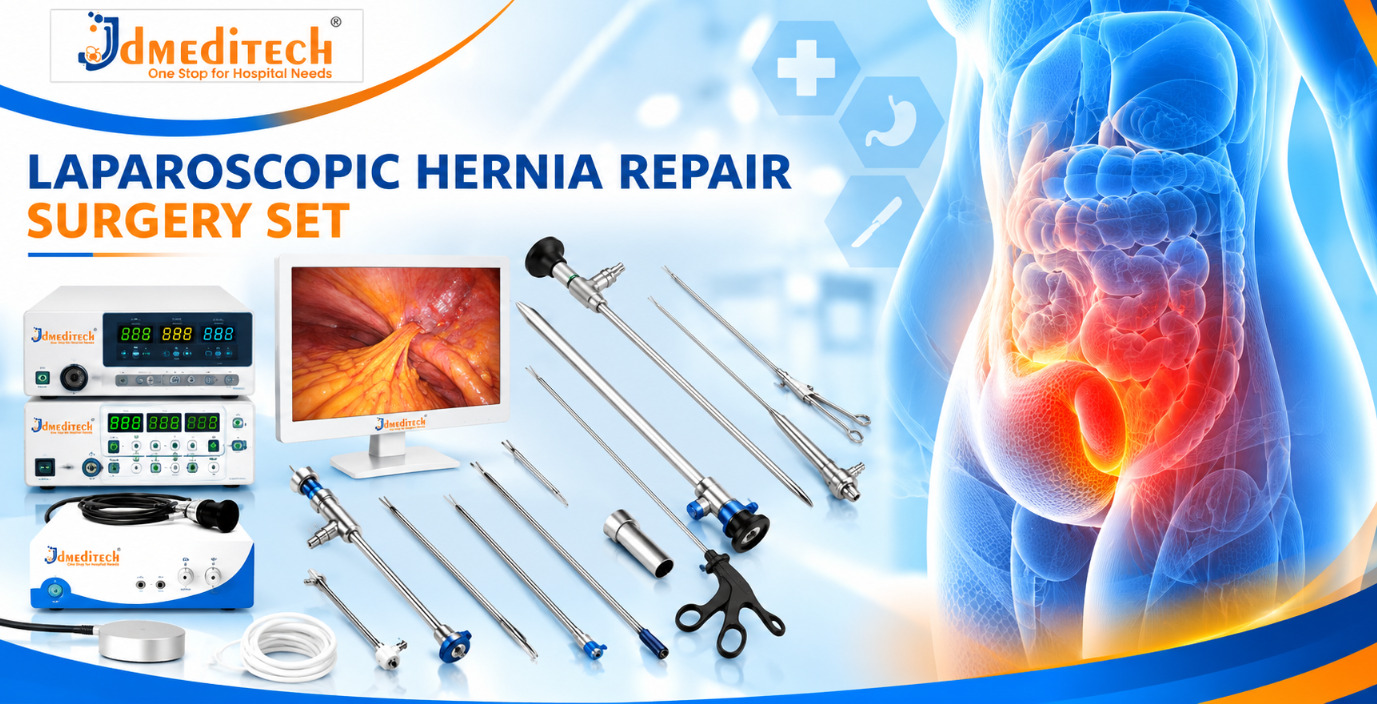
Laparoscopic Hernia Repair Surgery Set: Instruments, Uses & Procedure
A Laparoscopic Hernia Repair Surgery Set includes specialized instruments and equipment designed to support minimally invasive hernia repair procedures. Surgeons use laparoscopic visualization and long surgical instruments through small access ports to identify and repair a hernia.
Depending on the clinical situation, surgeons may use different laparoscopic approaches. For example, TAPP and TEP are commonly recognized approaches for laparoscopic inguinal hernia repair. Therefore, selecting suitable instruments, visualization equipment, access devices, and compatible accessories is an important part of surgical preparation.
In this article, we explain the instruments used for laparoscopic hernia repair, their functions, common equipment, TAPP and TEP techniques, and important factors to consider when selecting a surgery set.
What Is Laparoscopic Hernia Repair?
Laparoscopic hernia repair is a minimally invasive surgical approach. Instead of making one larger surgical incision, the surgeon works through small access points using a laparoscope and specialized surgical instruments.
A laparoscope provides visualization of the surgical area. Meanwhile, other instruments allow the surgeon to perform tissue handling, dissection, mesh placement, fixation, and other required surgical steps.
Therefore, the procedure requires both visualization equipment and specialized laparoscopic instruments.
What Is a Laparoscopic Hernia Repair Surgery Set?
A Laparoscopic Hernia Repair Surgery Set is a collection of instruments and equipment selected for minimally invasive hernia surgery.
The exact configuration can vary according to the surgical technique, surgeon preference, hospital requirements, and type of hernia. Therefore, hospitals should select instruments according to their specific procedural requirements.
A complete setup may include access instruments, graspers, scissors, dissectors, needle holders, electrosurgical instruments, suction and irrigation equipment, visualization systems, and other compatible accessories.
Instruments Used in Laparoscopic Hernia Repair
Different surgical steps require different instruments. Consequently, a laparoscopic hernia repair set can contain several types of devices.
1. Laparoscope
A laparoscope provides visualization of the internal surgical field. It connects to a compatible camera and light-source system so that the surgical team can view the procedure on a monitor.
Different telescope diameters and viewing angles may be available. Therefore, the selected laparoscope should match the surgeon’s technique and compatible equipment.
2. Trocar and Cannula
Trocars and cannulas provide access for the laparoscope and other laparoscopic instruments. Surgeons can use different diameters depending on the instruments required during the procedure.
In addition, trocar configuration and quantity can vary according to the surgical approach.
3. Laparoscopic Grasper
A laparoscopic grasper supports controlled tissue handling during surgery. Different jaw designs are available for different surgical requirements.
For example, atraumatic configurations may support gentle tissue manipulation. However, surgeons should select the appropriate design for the intended application.
4. Laparoscopic Dissector
A dissector helps the surgeon separate and manipulate tissue during the procedure. It can support precise dissection around the surgical area when used appropriately.
Different jaw shapes and lengths are available. Therefore, the surgeon can select a configuration according to the surgical technique.
5. Laparoscopic Scissors
Laparoscopic scissors support controlled tissue cutting. Depending on the instrument design, different blade configurations may be available.
Furthermore, the instrument should provide suitable handling and compatibility with the surgical setup.
6. Laparoscopic Needle Holder
A laparoscopic needle holder helps surgeons handle suturing needles during intracorporeal suturing. It supports needle positioning and manipulation through laparoscopic access.
Different handle and jaw designs may be available depending on surgeon preference.
7. Suction and Irrigation Instrument
A suction and irrigation system supports fluid management and visualization of the surgical field. Irrigation can help clear the operative area, while suction removes fluid when required.
Therefore, an appropriate suction and irrigation setup can support efficient surgical workflow.
8. Electrosurgical Instruments
Compatible monopolar or bipolar instruments may support tissue dissection and coagulation during laparoscopic procedures.
However, surgeons must use these instruments with compatible energy equipment and according to the manufacturer’s Instructions for Use.
9. Mesh Placement Instruments
Mesh commonly forms part of many hernia repair techniques. Therefore, surgeons may require suitable laparoscopic instruments to introduce, position, manipulate, and secure mesh according to the selected technique.
10. Laparoscopic Clip Applicator
A clip applicator can support clip placement when clinically required. Different clip and applicator configurations are available.
Consequently, hospitals should verify compatibility between the clip applicator and its intended clips before use.
Laparoscopic Hernia Repair Equipment
A complete laparoscopic setup requires more than hand instruments. In addition, hospitals may require visualization, insufflation, electrosurgical, and fluid-management equipment.
Depending on the procedure and hospital setup, equipment may include:
- HD laparoscopic camera system
- Medical monitor
- LED or compatible light source
- CO2 insufflator
- Electrosurgical unit
- Suction and irrigation system
- Laparoscope or telescope
- Camera head and coupler
- Light cable
- Compatible laparoscopic instruments
Therefore, buyers should verify compatibility between individual components before finalizing a complete surgical system.
Common Instruments in a Laparoscopic Hernia Repair Surgery Set
| Instrument / Equipment | General Function |
|---|---|
| Laparoscope | Provides visualization of the surgical field |
| Trocar & Cannula | Provides access for laparoscopic instruments |
| Grasper | Supports tissue handling and manipulation |
| Dissector | Supports tissue separation and dissection |
| Scissors | Supports controlled tissue cutting |
| Needle Holder | Supports laparoscopic suturing |
| Suction & Irrigation | Supports fluid management and visualization |
| Clip Applicator | Supports compatible surgical clip placement |
| Electrosurgical Instrument | Supports appropriate dissection and coagulation |
| Camera System | Captures and displays the operative field |
| Light Source | Provides illumination for endoscopic visualization |
| CO2 Insufflator | Supports creation and maintenance of pneumoperitoneum |
TAPP vs TEP Hernia Repair
TAPP and TEP are two recognized laparo-endoscopic approaches used for inguinal hernia repair. Although both approaches can access the preperitoneal space for hernia repair, they use different access routes.
What Is TAPP?
TAPP stands for Transabdominal Preperitoneal repair.
In this approach, the surgeon enters the abdominal cavity and then accesses the preperitoneal space. The surgeon performs the repair according to the selected surgical technique.
What Is TEP?
TEP stands for Totally Extraperitoneal repair.
In contrast to TAPP, the TEP approach accesses the preperitoneal space without intentionally entering the peritoneal cavity as part of the standard technique.
TAPP vs TEP: Key Differences
| Feature | TAPP | TEP |
|---|---|---|
| Full Form | Transabdominal Preperitoneal | Totally Extraperitoneal |
| General Approach | Transabdominal access followed by preperitoneal repair | Preperitoneal access without intentional entry into the peritoneal cavity |
| Visualization | Includes intraperitoneal visualization | Operates primarily within the extraperitoneal space |
| Technique Selection | Depends on clinical factors and surgeon expertise | Depends on clinical factors and surgeon expertise |
Neither approach is automatically suitable for every patient. Therefore, surgeons select the appropriate technique according to patient factors, hernia characteristics, training, experience, and clinical judgment.
How Is Laparoscopic Hernia Repair Performed?
First, the surgical team prepares the patient and laparoscopic equipment according to the planned procedure. The surgeon then establishes appropriate access and visualization.
Next, the surgeon identifies the hernia and relevant anatomical structures. Specialized laparoscopic instruments support tissue handling and dissection during the procedure.
Depending on the technique, the surgeon can then position suitable mesh to reinforce the required area. After completing the repair, the surgeon performs the remaining procedural steps according to the selected technique.
However, surgical steps vary according to hernia type, anatomy, technique, patient condition, and surgeon preference. Therefore, trained healthcare professionals should follow established clinical protocols.
Key Features of a Laparoscopic Hernia Repair Surgery Set
A suitable surgery set should support the different stages of the planned laparoscopic procedure. Moreover, instrument quality and compatibility are important considerations.
Important features can include:
- Suitable medical-grade construction
- Ergonomic instrument handling
- Appropriate instrument lengths and diameters
- Compatible trocar and cannula sizes
- Reliable grasping and dissection mechanisms
- Suitable visualization equipment
- Compatible energy instruments where required
- Easy instrument identification
- Appropriate reusable or single-use configurations
- Compatibility with the intended surgical system
How to Select Laparoscopic Hernia Instruments
Hospitals and medical professionals should consider several factors when selecting laparoscopic hernia instruments. First, they should identify the planned surgical technique and required instrument configuration.
Next, buyers should check the required diameter, working length, jaw design, handle configuration, and equipment compatibility.
Important selection factors include:
- Type of hernia procedure
- TAPP or TEP technique requirements
- Instrument diameter
- Instrument working length
- Jaw and tip design
- Trocar compatibility
- Camera and telescope compatibility
- Energy-system compatibility
- Reusable or single-use requirement
- Sterilization requirements for reusable devices
- Hospital and surgeon preferences
As a result, clearly defining technical requirements before purchasing can help buyers select a more appropriate surgical set.
Benefits of a Complete Laparoscopic Surgery Set
A properly configured surgery set helps the operating room team organize the required instruments for the planned procedure.
In addition, compatible instruments and equipment can support an efficient procedural workflow. Standardized instrument configurations may also simplify preparation, inventory management, and instrument identification.
However, hospitals should configure every set according to their own procedural requirements rather than assuming that one standard set is appropriate for every operation.
JDMeditech Laparoscopic Hernia Repair Surgery Set
JDMeditech provides laparoscopic surgical instruments, accessories, and equipment for hospitals, surgical centres, healthcare facilities, medical distributors, and international buyers.
Our Laparoscopic Hernia Repair Surgery Set can be configured according to customer requirements. Therefore, customers can discuss the required instruments, sizes, lengths, quantities, and equipment configuration with our team.
JDMeditech’s laparoscopy portfolio includes various instruments and equipment for minimally invasive surgical procedures.
Explore our laparoscopy product range or contact JDMeditech with your required instrument list for product information and quotation.
Who Can Purchase Laparoscopic Hernia Repair Surgery Sets?
JDMeditech supplies medical and surgical products for different healthcare requirements. Depending on applicable local requirements, potential buyers can include hospitals, surgical centres, medical-device distributors, healthcare procurement organizations, and other authorized medical buyers.
International distributors can also contact JDMeditech with product specifications and quantities for export enquiries.
Frequently Asked Questions
What is a Laparoscopic Hernia Repair Surgery Set?
A Laparoscopic Hernia Repair Surgery Set is a collection of instruments and equipment selected to support minimally invasive hernia repair procedures.
Which instruments are used for laparoscopic hernia repair?
Depending on the procedure, instruments may include a laparoscope, trocars, graspers, dissectors, scissors, needle holders, suction and irrigation instruments, clip applicators, and compatible electrosurgical instruments.
What equipment is required for laparoscopic hernia surgery?
The setup may include a camera system, medical monitor, light source, CO2 insufflator, laparoscope, electrosurgical equipment, and compatible surgical instruments. However, exact requirements depend on the procedure and hospital setup.
What is TAPP hernia repair?
TAPP stands for Transabdominal Preperitoneal repair. It is a laparo-endoscopic approach in which the surgeon enters the abdominal cavity before accessing the preperitoneal space for repair.
What is TEP hernia repair?
TEP stands for Totally Extraperitoneal repair. The technique accesses the preperitoneal space without intentionally entering the peritoneal cavity as part of the standard approach.
What is the difference between TAPP and TEP?
The primary difference is the access route. TAPP involves transabdominal access, while TEP primarily uses an extraperitoneal approach. The appropriate technique depends on clinical requirements and surgeon expertise.
Does JDMeditech provide customized laparoscopic surgery sets?
Customers can contact JDMeditech with their required instrument names, sizes, lengths, configurations, and quantities. The team can then discuss suitable available product options and quotation requirements.
Conclusion
Overall, a Laparoscopic Hernia Repair Surgery Set combines instruments and equipment used to support minimally invasive hernia repair procedures. Depending on the planned procedure, the set may include laparoscopes, trocars, graspers, dissectors, scissors, needle holders, suction and irrigation instruments, and visualization equipment.
Furthermore, TAPP and TEP represent two important laparo-endoscopic approaches for inguinal hernia repair. Therefore, surgeons and hospitals should select instruments according to the planned technique, patient requirements, equipment compatibility, and clinical protocols.
Finally, hospitals, surgical centres, medical distributors, and international buyers can contact JDMeditech for information about laparoscopic instruments, available configurations, quantities, and quotation requirements.
Disclaimer: This article is intended for general educational and product-information purposes only. It does not replace professional medical advice, clinical judgment, surgical training, institutional protocols, applicable guidelines, or the manufacturer’s Instructions for Use.




