



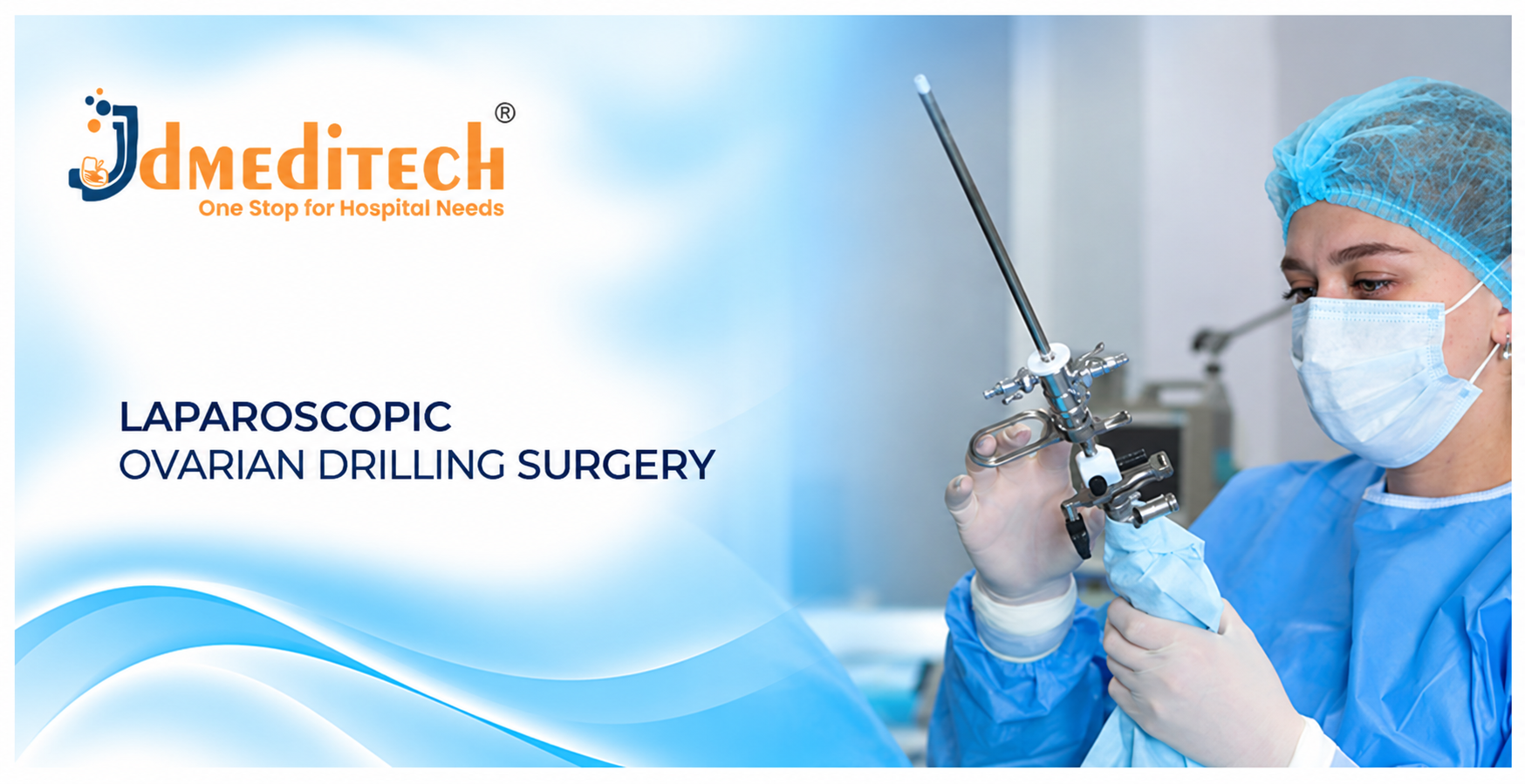
Introduction to Laparoscopic Ovarian Drilling Surgery
Laparoscopic Ovarian Drilling Surgery is a minimally invasive gynecological procedure that may help restore ovulation in selected women with polycystic ovary syndrome (PCOS). During the operation, surgeons use a laparoscope and specialized surgical instruments to deliver controlled energy to selected ovarian tissue.
PCOS is a common hormonal and metabolic condition that can affect menstrual cycles, ovulation, and fertility. Consequently, some women experience irregular periods or difficulty becoming pregnant. Furthermore, hormonal changes associated with PCOS can influence reproductive and metabolic health.
However, ovarian drilling is not a routine treatment for every patient with PCOS. Instead, fertility specialists generally recommend appropriate nonsurgical treatments first. Therefore, doctors carefully evaluate the patient’s medical history, fertility goals, and previous treatment response before considering surgery.
In this comprehensive guide, JDMeditech explains laparoscopic ovarian drilling surgery, its clinical applications, surgical instruments, possible benefits, risks, recovery, and frequently asked questions.
What Is Laparoscopic Ovarian Drilling Surgery?
Laparoscopic ovarian drilling, also known as laparoscopic ovarian diathermy, is a surgical procedure that uses controlled energy to treat selected areas of ovarian tissue. Primarily, doctors consider this approach for certain patients with PCOS-related anovulatory infertility.
During the procedure, the laparoscope provides magnified images of the ovaries and surrounding pelvic structures. Meanwhile, a compatible electrosurgical instrument allows the surgeon to perform the planned treatment.
As a result, some patients may experience changes in ovarian hormone activity and improved ovulation. Nevertheless, the response varies between individuals, and surgery does not guarantee pregnancy.
Understanding Polycystic Ovary Syndrome (PCOS)
Polycystic ovary syndrome is a hormonal and metabolic condition that can affect reproductive health. In particular, PCOS may involve irregular ovulation, increased androgen activity, and metabolic changes.
For example, some patients experience irregular menstrual periods, acne, or excess facial hair. Additionally, others seek medical advice because they have difficulty conceiving.
However, the presence of polycystic ovarian morphology alone does not confirm PCOS. Therefore, doctors use established diagnostic criteria and appropriate clinical assessments.
Furthermore, PCOS management often involves long-term attention to metabolic health, reproductive goals, and individual symptoms.
Common Symptoms of PCOS
Symptoms of PCOS differ between patients. Nevertheless, several common features may indicate the need for medical assessment.
- Irregular or infrequent menstrual periods
- Absent or unpredictable ovulation
- Difficulty becoming pregnant
- Acne and oily skin
- Excess facial or body hair
- Scalp hair thinning
- Insulin resistance in some patients
- Weight-management difficulties in some individuals
- Other reproductive or metabolic concerns
Importantly, these symptoms can occur with other conditions. Therefore, patients should consult a qualified healthcare professional for an accurate diagnosis.
Why Is Laparoscopic Ovarian Drilling Performed?
Doctors may consider laparoscopic ovarian drilling for selected women with PCOS-related anovulatory infertility when appropriate ovulation-induction treatment has not produced the desired response.
For instance, international PCOS guidance identifies laparoscopic ovarian surgery as a possible second-line option in selected patients with clomiphene-resistant anovulatory infertility and no other infertility factors.
However, gonadotrophin treatment and other fertility approaches may also be appropriate. Consequently, the specialist must compare the expected benefits, possible complications, treatment costs, and patient preferences.
Above all, ovarian drilling should support an individualized fertility treatment plan rather than serve as a general treatment for PCOS.
Who May Be Suitable for Ovarian Drilling?
A fertility specialist may discuss ovarian drilling when a patient meets appropriate clinical criteria. Additionally, the doctor considers whether the expected benefits justify the surgical risks.
- Women with a confirmed diagnosis of PCOS
- Patients experiencing anovulatory infertility
- Patients who have not responded to suitable oral ovulation-induction treatment
- Patients without other significant infertility factors
- Patients who understand available medical alternatives
- Patients who accept the potential surgical risks
Furthermore, the fertility team reviews the patient’s age, ovarian reserve, previous treatments, and reproductive goals before recommending surgery.
When Is Ovarian Drilling Not Recommended?
Ovarian drilling is not necessary for every woman with PCOS. For example, doctors generally avoid recommending it solely because an ultrasound shows polycystic ovarian morphology.
Similarly, patients who are not seeking pregnancy may benefit more from treatments directed toward menstrual, hormonal, or metabolic symptoms.
Moreover, other causes of infertility may require different management. Therefore, a complete fertility evaluation remains important.
Medical Treatment Options Before Ovarian Drilling
Before recommending surgery, fertility specialists generally consider suitable medical and lifestyle approaches. The treatment plan depends on the patient’s condition and reproductive goals.
1. Lifestyle and Metabolic Management
Healthy lifestyle measures support overall health in patients with PCOS. Additionally, individualized nutrition, physical activity, and metabolic care may improve selected health outcomes.
However, doctors should avoid assuming that every patient with PCOS needs weight loss.
2. Letrozole for Ovulation Induction
Letrozole is the recommended first-line pharmacological ovulation-induction treatment for eligible women with PCOS-related anovulatory infertility and no other infertility factors.
Nevertheless, prescribing rules and approved indications differ between countries. Therefore, a qualified clinician must supervise its use.
3. Clomiphene Citrate
Clomiphene citrate is another medication used for ovulation induction. However, current international guidance generally favors letrozole for suitable patients.
4. Metformin
Metformin may help selected patients with PCOS, particularly when metabolic concerns are present. Furthermore, clinicians may consider it within an individualized treatment plan.
However, metformin alone is not necessarily the most effective ovulation-induction treatment.
5. Gonadotrophin Therapy
Gonadotrophins can stimulate ovarian follicle development and ovulation. Additionally, they may serve as a second-line treatment after unsuccessful oral ovulation induction.
However, careful monitoring is important because multiple pregnancy and ovarian hyperstimulation are potential risks.
How Does Laparoscopic Ovarian Drilling Work?
Laparoscopic ovarian drilling uses controlled energy to treat selected areas of ovarian tissue. The procedure may influence ovarian androgen production and support more regular ovulation in some patients.
Consequently, menstrual cycles may become more predictable after treatment. In addition, selected patients may experience spontaneous ovulation without further medication.
However, outcomes vary, and the improvement may not continue indefinitely. Furthermore, excessive treatment can damage healthy ovarian tissue.
Therefore, qualified surgeons must carefully balance the potential fertility benefits against the risks of ovarian injury.
How Is Laparoscopic Ovarian Drilling Surgery Performed?
A qualified gynecological surgeon performs laparoscopic ovarian drilling in an appropriately equipped operating room. Generally, the procedure takes place under general anesthesia.
First, the surgical team reviews the patient’s medical history, fertility assessment, and treatment plan. Next, the anesthesia team prepares the patient for the operation.
After establishing laparoscopic access, the surgeon examines the pelvic anatomy using the camera system. Subsequently, a compatible surgical energy instrument supports the planned ovarian treatment.
Throughout the procedure, the surgeon aims to minimize unnecessary injury to healthy ovarian tissue and nearby structures. Finally, the surgical team completes the operation and closes the small abdominal incisions.
Importantly, the exact surgical technique depends on the patient’s clinical condition and the surgeon’s professional judgment.
Essential Instruments Used in Laparoscopic Ovarian Drilling Surgery
Laparoscopic ovarian drilling instruments support visualization, abdominal access, tissue handling, energy delivery, and surgical monitoring.
Furthermore, every instrument must match the planned procedure and the operating room equipment. The following list describes common instrument categories rather than a confirmed JDMeditech surgical kit.
1. Laparoscope Telescope
A laparoscope provides magnified images of the pelvic organs. Consequently, surgeons can visualize the ovaries and surrounding anatomical structures during surgery.
2. Laparoscopic Camera System
A compatible camera system transfers images from the laparoscope to a surgical monitor. Additionally, suitable image quality supports controlled surgical work.
3. Medical Light Source
A medical light source illuminates the operative field. Therefore, the surgeon can observe relevant anatomical structures more clearly.
4. Fiber-Optic Light Cable
A compatible light cable transfers illumination from the light source to the laparoscope. Furthermore, appropriate equipment compatibility supports reliable visualization.
5. Laparoscopic Trocar
A laparoscopic trocar forms part of the abdominal access system. It supports the introduction of compatible surgical instruments.
6. Laparoscopic Cannula
A cannula maintains an access pathway for surgical instruments. Additionally, the surgical team selects suitable dimensions for the planned procedure.
7. CO2 Insufflator
A carbon dioxide insufflator helps maintain the abdominal working space. As a result, surgeons gain room for visualization and instrument movement.
8. Laparoscopic Grasping Forceps
Grasping forceps support controlled handling of suitable tissues. Furthermore, different jaw designs serve different surgical applications.
9. Atraumatic Grasper
An atraumatic grasper helps surgeons manipulate delicate tissues. Therefore, it may support appropriate tissue positioning during the operation.
10. Ovarian Drilling Electrode
A compatible ovarian drilling electrode delivers controlled energy during the planned treatment. Importantly, surgeons must follow the device’s approved intended use and safety instructions.
11. Monopolar Electrosurgical Generator
A compatible monopolar generator supplies electrosurgical energy to suitable instruments. However, safe use requires appropriate settings, equipment compatibility, and professional training.
12. Bipolar Forceps
Bipolar forceps support selected coagulation tasks. Additionally, surgeons use them with compatible electrosurgical equipment.
13. Maryland Dissector
A Maryland dissector supports fine tissue separation when the operation requires it. Moreover, its design helps surgeons perform controlled manipulation during suitable surgical tasks.
14. Laparoscopic Scissors
Laparoscopic scissors support controlled tissue cutting. Furthermore, the surgical team selects suitable blade designs and working lengths.
15. Suction and Irrigation Cannula
Suction and irrigation instruments help manage fluids in the operative field. Consequently, the team can maintain visibility during appropriate surgical tasks.
16. Laparoscopic Needle Holder
A laparoscopic needle holder supports suturing when the operation requires tissue repair or closure.
17. Surgical Monitor
A medical-grade monitor displays laparoscopic camera images. Therefore, the surgical team can observe the operative field throughout the procedure.
18. Endoscopy Trolley
An endoscopy trolley supports organized placement of laparoscopic equipment. Additionally, proper arrangement helps the team manage the surgical setup.
19. Sterile Surgical Accessories
Compatible drapes, tubing, dressings, and other sterile accessories support the planned procedure. Furthermore, the healthcare team follows appropriate infection-control practices.
Laparoscopic Ovarian Drilling Instruments and Their Functions
The following table summarizes common laparoscopic equipment categories. However, the exact instrument list depends on the surgeon’s technique and available surgical systems.
| Surgical Instrument | Primary Function |
|---|---|
| Laparoscope | Provides pelvic visualization |
| Camera System | Displays operative images |
| Light Source | Provides illumination |
| Trocar and Cannula | Support laparoscopic access |
| CO2 Insufflator | Maintains abdominal working space |
| Grasping Forceps | Support tissue handling |
| Atraumatic Grasper | Supports delicate tissue manipulation |
| Ovarian Drilling Electrode | Delivers controlled surgical energy |
| Electrosurgical Generator | Supplies compatible surgical energy |
| Bipolar Forceps | Support coagulation |
| Maryland Dissector | Supports fine tissue dissection |
| Laparoscopic Scissors | Support controlled tissue cutting |
| Suction and Irrigation | Support fluid management |
| Surgical Monitor | Displays operative images |
Potential Benefits of Laparoscopic Ovarian Drilling Surgery
Laparoscopic ovarian drilling may offer reproductive benefits for carefully selected patients with PCOS-related anovulatory infertility. However, outcomes vary, and surgery does not guarantee pregnancy.
1. Improved Ovulation
Some patients begin ovulating more regularly after surgery. Consequently, natural conception may become possible in suitable circumstances.
2. Better Menstrual Regularity
Some women experience more predictable menstrual cycles after treatment. Nevertheless, the improvement may not continue indefinitely.
3. Reduced Need for Additional Medication
Selected patients may ovulate without further ovulation-induction medication. However, others still require fertility treatment.
4. Avoidance of Multiple Follicle Stimulation
When ovarian drilling restores spontaneous ovulation, it avoids the medication-related multiple follicle stimulation associated with gonadotrophin therapy. As a result, the treatment may reduce certain multiple-pregnancy risks compared with gonadotrophin-based stimulation.
5. Minimally Invasive Surgical Access
Laparoscopic surgery generally uses small abdominal incisions. Consequently, selected patients may experience shorter early recovery than after comparable open procedures.
6. Individualized Fertility Management
Ovarian drilling provides an additional treatment option for selected patients. Furthermore, specialists can consider it alongside other fertility approaches after reviewing individual circumstances.
Risks and Complications of Ovarian Drilling Surgery
Like other surgical procedures, laparoscopic ovarian drilling carries potential risks. Therefore, patients should discuss possible complications before choosing treatment.
- Bleeding during or after surgery
- Surgical-site infection
- Injury to nearby organs or blood vessels
- Anesthesia-related complications
- Postoperative abdominal discomfort
- Pelvic adhesion formation
- Unintended ovarian tissue damage
- Possible reduction in ovarian reserve
- Persistent ovulation problems
- Continued infertility
- Possible need for additional fertility treatment
Importantly, excessive ovarian tissue damage may affect future reproductive potential. Therefore, the procedure requires careful patient selection and qualified surgical expertise.
Ovarian Reserve After Laparoscopic Ovarian Drilling
Ovarian reserve refers to the remaining egg supply within the ovaries. Doctors assess ovarian reserve using clinical information and selected fertility investigations.
Because ovarian drilling affects ovarian tissue, specialists consider its potential impact on ovarian reserve. Furthermore, excessive tissue damage may reduce the number of healthy follicles.
However, ovarian reserve test results do not directly guarantee or exclude natural pregnancy. Therefore, fertility specialists interpret these findings alongside the patient’s age and reproductive history.
Can Ovarian Drilling Improve Pregnancy Chances?
Ovarian drilling may restore ovulation in selected patients with PCOS-related anovulatory infertility. Consequently, some women may become pregnant after treatment.
However, pregnancy also depends on age, sperm quality, fallopian tube function, and other reproductive factors. Additionally, some patients may require further ovulation induction or assisted reproductive treatment.
Therefore, fertility specialists should discuss realistic outcomes rather than promise pregnancy after surgery.
Laparoscopic Ovarian Drilling vs Ovulation-Induction Medication
| Feature | Ovarian Drilling | Ovulation-Induction Medication |
|---|---|---|
| Treatment Approach | Minimally invasive surgery | Medication-based treatment |
| Typical Role | Selected second-line cases | First-line or second-line treatment |
| General Anesthesia | Usually required | Usually not required |
| Monitoring | Surgical and fertility follow-up | Cycle monitoring as appropriate |
| Important Risks | Adhesions, surgical injury, ovarian damage | Medication-related effects and multiple pregnancy risk |
| Guaranteed Pregnancy | No | No |
Overall, both approaches have benefits and limitations. Therefore, the fertility specialist should recommend treatment according to the patient’s individual needs.
Recovery After Laparoscopic Ovarian Drilling Surgery
Recovery depends on the patient’s general health, surgical findings, and any additional procedures. However, many patients gradually resume light activities after uncomplicated laparoscopy.
Initially, patients may experience abdominal discomfort, fatigue, or incision tenderness. Additionally, carbon dioxide used during surgery can contribute to temporary shoulder-tip discomfort.
Over time, patients can gradually return to normal activities according to their surgeon’s instructions. Nevertheless, strenuous exercise and heavy lifting may require temporary restrictions.
Furthermore, the fertility team may recommend follow-up appointments to assess menstrual regularity and ovulation.
Postoperative Care After Ovarian Drilling
Appropriate postoperative care supports healing and helps identify complications early. Therefore, patients should follow the healthcare team’s instructions.
- Take prescribed medicines as directed
- Keep surgical wounds clean and dry as instructed
- Attend scheduled follow-up appointments
- Follow lifting and exercise restrictions
- Monitor menstrual cycles when advised
- Discuss ovulation tracking with the fertility specialist
- Report unexpected pain or other symptoms
- Continue the recommended fertility treatment plan
Additionally, patients should seek medical advice if they develop fever, worsening abdominal pain, or unusual wound discharge.
Warning Signs After Laparoscopic Ovarian Drilling
Although many patients recover without serious complications, some symptoms require prompt medical attention.
- Persistent or worsening abdominal pain
- High or persistent fever
- Repeated vomiting
- Increasing abdominal swelling
- Significant wound redness or discharge
- Heavy bleeding
- Leg swelling or pain
- Difficulty breathing
- Severe weakness or fainting
Importantly, difficulty breathing, uncontrolled bleeding, or other serious symptoms require emergency medical care.
How to Choose Laparoscopic Ovarian Drilling Instruments
Hospitals and gynecology departments should carefully evaluate their equipment requirements before purchasing laparoscopic surgical instruments.
First, purchasing teams should identify the planned procedures and required instrument functions. Next, they should review laparoscope specifications, trocar dimensions, and instrument working lengths.
Furthermore, hospitals should confirm compatibility between the ovarian drilling electrode, electrosurgical generator, camera system, and light source.
Finally, teams should review manufacturer instructions, cleaning requirements, approved intended uses, and applicable regulatory documentation.
Important Equipment Selection Factors
- Approved intended use
- Planned gynecological procedure
- Laparoscope diameter and viewing angle
- Camera system compatibility
- Medical light source compatibility
- Trocar and cannula dimensions
- CO2 insufflator compatibility
- Ovarian drilling electrode specifications
- Electrosurgical generator compatibility
- Grasper jaw design
- Instrument working length
- Suction and irrigation requirements
- Reusable or single-use classification
- Cleaning and sterilization instructions
- Manufacturer technical documentation
- Applicable regulatory documentation
Laparoscopic Surgical Instruments – JDMeditech
JDMeditech welcomes inquiries from hospitals, gynecology departments, fertility centers, laparoscopic surgery units, and international medical distributors regarding laparoscopic surgical instruments and related accessories.
For example, customers can inquire about available laparoscopic telescopes, grasping forceps, dissecting forceps, scissors, and compatible surgical accessories.
Furthermore, the JDMeditech team can discuss available product configurations, technical specifications, intended uses, and applicable documentation.
Therefore, hospitals and distributors can contact JDMeditech to discuss their specific surgical instrument requirements.
For product information and international business inquiries, visit www.jdmeditech.com.
Frequently Asked Questions About Laparoscopic Ovarian Drilling Surgery
1. What is laparoscopic ovarian drilling surgery?
It is a minimally invasive procedure that uses controlled energy on selected ovarian tissue. Doctors may consider it for certain patients with PCOS-related anovulatory infertility.
2. Is ovarian drilling a treatment for PCOS?
It may help selected patients with PCOS-related infertility. However, it does not cure PCOS or treat every symptom.
3. Who may benefit from ovarian drilling?
Selected patients with anovulatory infertility who have not responded to suitable ovulation-induction treatment may benefit.
4. Is ovarian drilling the first treatment for PCOS infertility?
No. Doctors generally recommend appropriate nonsurgical ovulation-induction treatment first.
5. Can ovarian drilling restore ovulation?
Yes, in some patients. However, the response varies and may not last indefinitely.
6. Can pregnancy occur after ovarian drilling?
Yes. Some patients become pregnant after ovulation returns. Nevertheless, surgery does not guarantee pregnancy.
7. Does ovarian drilling remove the ovaries?
No. Unlike oophorectomy, ovarian drilling treats selected areas of ovarian tissue while preserving the ovaries.
8. What instruments do surgeons use during ovarian drilling?
Common instruments include a laparoscope, trocars, graspers, a compatible energy electrode, and an electrosurgical generator.
9. Does ovarian drilling require general anesthesia?
Yes. Surgeons generally perform laparoscopic ovarian drilling under general anesthesia.
10. What are the main risks of ovarian drilling?
Potential risks include bleeding, infection, organ injury, adhesions, and damage to ovarian tissue.
11. Can ovarian drilling reduce ovarian reserve?
Yes. Ovarian tissue damage may affect ovarian reserve. Therefore, specialists carefully consider the risks before recommending surgery.
12. Is ovarian drilling better than fertility medication?
Not necessarily. Treatment outcomes and risks vary. Consequently, doctors compare suitable medical and surgical options for each patient.
13. What is the difference between ovarian drilling and ovarian cystectomy?
Ovarian drilling aims to influence ovulation in selected PCOS cases. In contrast, ovarian cystectomy removes an ovarian cyst while attempting to preserve ovarian tissue.
14. What is the difference between ovarian drilling and oophorectomy?
Ovarian drilling treats selected ovarian tissue. However, oophorectomy removes one or both ovaries.
15. How long does ovarian drilling surgery take?
Operation time depends on the patient’s anatomy, surgical findings, and any additional procedures. Therefore, the surgeon provides an individual estimate.
16. How long is the hospital stay?
Some patients return home on the same day. However, others may need a longer stay depending on their condition.
17. How long does recovery take?
Recovery varies between patients. In general, the surgeon provides guidance on activity restrictions and follow-up care.
18. Can menstrual cycles become regular after ovarian drilling?
Yes, some patients experience more regular cycles. Nevertheless, others continue to have irregular periods.
19. Does ovarian drilling permanently cure PCOS?
No. PCOS is a long-term condition, and ovarian drilling does not permanently cure its hormonal or metabolic features.
20. Where can hospitals inquire about JDMeditech laparoscopic instruments?
Hospitals and medical distributors can visit JDMeditech to inquire about available laparoscopic surgical instruments and accessories.
Conclusion
Laparoscopic Ovarian Drilling Surgery may help restore ovulation in selected patients with PCOS-related anovulatory infertility. Furthermore, the minimally invasive approach allows qualified surgeons to perform the planned treatment through small abdominal incisions.
However, ovarian drilling is not suitable for every patient with PCOS. Therefore, specialists must consider medical alternatives, ovarian reserve, fertility goals, and potential surgical complications before recommending treatment.
Additionally, appropriate patient selection, compatible laparoscopic instruments, and postoperative monitoring remain important aspects of surgical care.
For laparoscopic surgical instrument inquiries and international business requirements, contact JDMeditech – One Stop for Hospital Needs.
Website: www.jdmeditech.com
Medical Disclaimer: This article provides general educational information only. It does not replace professional medical advice, fertility counseling, or surgical training. Qualified healthcare professionals must make treatment and equipment decisions according to current clinical guidance, local regulations, and approved manufacturer instructions.




