



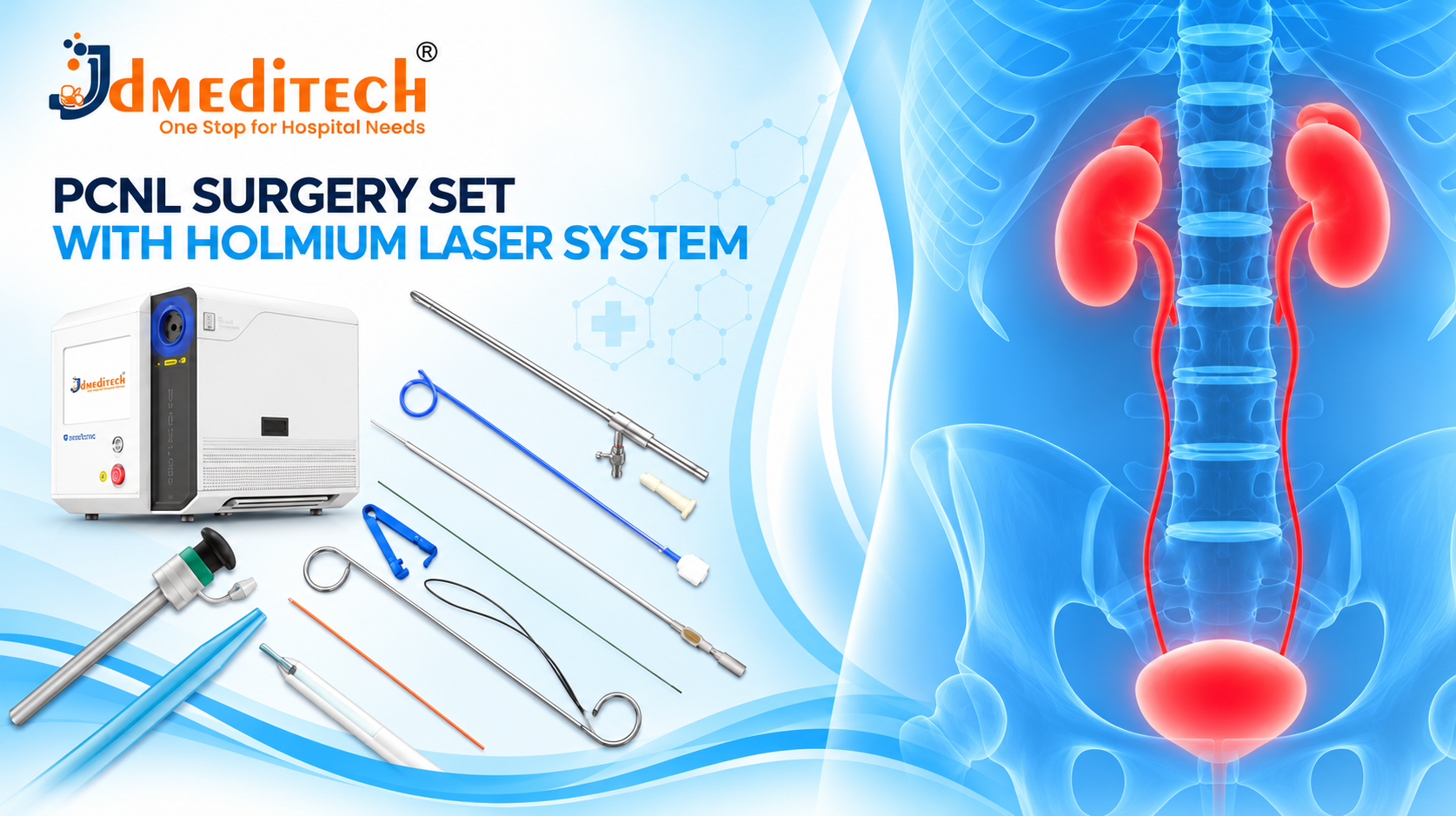
PCNL Surgery Set with Holmium Laser System: Instruments, Uses and Benefits
A PCNL Surgery Set with Holmium Laser System combines specialized urology instruments with compatible laser lithotripsy equipment for kidney stone treatment. Percutaneous nephrolithotomy (PCNL) is a minimally invasive surgical procedure used to remove selected large or complex kidney stones.
During PCNL, a urologist accesses the kidney through a small incision in the back. A nephroscope provides direct visualization, while compatible lithotripsy equipment helps fragment stones for removal.
JDMeditech offers urology instruments and accessories for hospitals, surgical centers, and medical distributors. This guide explains the common components, applications, features, and selection considerations for PCNL equipment with a holmium laser system.
What Is a PCNL Surgery Set with Holmium Laser System?
A PCNL Surgery Set includes compatible surgical instruments used during percutaneous nephrolithotomy procedures.
When combined with a suitable holmium laser system, the equipment may support laser-based stone fragmentation. The surgeon can then remove selected fragments using compatible instruments.
However, the exact equipment configuration depends on the procedure, access tract, endoscope, and clinical requirements.
What Is a Holmium Laser System?
A holmium laser system, commonly known as a Ho:YAG laser, uses laser energy delivered through a compatible optical fiber.
In urology, holmium laser lithotripsy is used to fragment urinary stones during suitable endoscopic procedures.
Unlike pneumatic lithotripsy, which uses mechanical impact, holmium laser lithotripsy delivers laser energy to the target stone.
Therefore, the laser generator, fiber, endoscope, and operating parameters must be compatible with the intended application.
Common Instruments Used in a PCNL Surgery Set
Different PCNL procedures require different instruments. The following components are commonly associated with PCNL and laser lithotripsy.
1. Holmium Laser Generator
The holmium laser generator provides laser energy for compatible lithotripsy applications.
Its available settings and operating capabilities depend on the specific equipment model.
2. Nephroscope
A nephroscope allows the surgeon to visualize the kidney’s collecting system during PCNL.
Moreover, compatible nephroscopes provide working channels for selected surgical instruments.
3. Laser Fiber
A compatible laser fiber transfers laser energy from the generator to the target stone.
Therefore, fiber diameter and operating limits must match the laser system and endoscope.
4. PCN Puncture Needle
A percutaneous puncture needle is used to establish initial access to the kidney’s collecting system.
Access is planned and performed by trained professionals using appropriate imaging guidance.
5. Urology Guide Wire
A guide wire helps establish and maintain the selected access pathway.
In addition, compatible guide wires support the introduction of certain access instruments.
6. Renal Dilator Set
Renal dilators help prepare the percutaneous access tract for the selected endoscopic system.
Different PCNL approaches may require different dilation techniques and instrument sizes.
7. Amplatz Sheath
An Amplatz sheath provides a working access channel during compatible PCNL procedures.
Moreover, it can support instrument passage and fluid outflow.
8. Stone Retrieval Forceps
Compatible stone retrieval forceps help remove selected stone fragments.
However, the instrument dimensions must match the selected nephroscope and access system.
9. Irrigation Accessories
Irrigation equipment helps maintain visibility during endoscopic surgery.
Furthermore, appropriate fluid management is important for procedural safety.
10. Drainage Accessories
A nephrostomy tube or ureteral stent may be used after selected PCNL procedures.
However, drainage requirements depend on the surgical findings and clinical judgment.
PCNL Surgery Set Components and Functions
| Instrument | Primary Function |
|---|---|
| Holmium Laser Generator | Provides laser energy for compatible stone fragmentation |
| Nephroscope | Supports visualization of the kidney collecting system |
| Laser Fiber | Transfers laser energy to the target stone |
| PCN Puncture Needle | Supports initial percutaneous access |
| Guide Wire | Helps maintain the access pathway |
| Renal Dilator Set | Supports preparation of the access tract |
| Amplatz Sheath | Provides an access channel for compatible instruments |
| Stone Retrieval Forceps | Support removal of suitable stone fragments |
| Irrigation Accessories | Support visibility and fluid management |
| Drainage Accessories | Support postoperative drainage when indicated |
These are examples of commonly used instruments, not a confirmed packing list for every PCNL system.
Key Features of a PCNL Surgery Set with Holmium Laser
1. Percutaneous Kidney Access
PCNL provides access to the kidney through a small incision rather than conventional open surgery.
As a result, it is an established minimally invasive treatment option for selected kidney stones.
2. Laser Stone Fragmentation
Compatible holmium laser equipment supports fragmentation of suitable urinary stones.
Moreover, the surgeon can select appropriate laser settings according to the equipment instructions and clinical requirements.
3. Direct Endoscopic Visualization
A suitable nephroscope allows the surgeon to examine the kidney’s collecting system.
Therefore, stone fragmentation and retrieval can be performed under endoscopic visualization.
4. Compatible Stone Retrieval
Selected retrieval instruments support the removal of suitable fragments.
However, the method depends on the stone characteristics and selected surgical system.
5. Multiple Instrument Configurations
PCNL equipment may be configured for standard or miniaturized percutaneous procedures.
Consequently, hospitals should verify the instrument dimensions and system compatibility before purchasing.
Applications of a PCNL Surgery Set
A PCNL Surgery Set with compatible holmium laser equipment may be used during selected kidney stone procedures.
- Treatment of selected large kidney stones
- Management of complex renal stone burdens
- Selected staghorn kidney stone procedures
- Laser fragmentation of suitable renal stones
- Endoscopic retrieval of selected stone fragments
- Selected procedures requiring percutaneous kidney access
PCNL is commonly recommended as a first-line treatment for renal stones larger than 2 cm.
Nevertheless, the final treatment decision depends on stone size, location, anatomy, infection status, and other clinical factors.
How Is PCNL Surgery with Holmium Laser Performed?
PCNL is performed by trained urologists in an appropriately equipped surgical setting.
First, the clinical team evaluates the patient using relevant imaging, laboratory investigations, and infection screening.
Next, the surgeon establishes percutaneous access to the kidney’s collecting system using appropriate guidance.
After preparing the access tract, a compatible nephroscope is introduced.
During the procedure, the surgeon locates the stone under endoscopic visualization.
If appropriate, a holmium laser and compatible fiber are used to fragment the stone.
Afterward, suitable instruments may remove selected fragments.
Finally, the surgeon evaluates the result and determines whether postoperative drainage is necessary.
The exact technique varies according to the patient’s condition and selected procedure.
Benefits of PCNL with Holmium Laser
1. Treatment of Large Kidney Stones
PCNL is an established treatment for selected large or complex renal stones.
In addition, it may be preferred when other treatment approaches are less suitable.
2. Minimally Invasive Surgical Access
PCNL uses a small percutaneous access tract.
However, it remains an invasive surgical procedure requiring anesthesia and appropriate clinical monitoring.
3. Laser Lithotripsy Option
Holmium laser lithotripsy offers an established method of fragmenting suitable urinary stones.
Moreover, laser fibers can be used through compatible endoscopic working channels.
4. Direct Visualization
A nephroscope provides visualization of the operative field.
Therefore, the surgeon can guide compatible instruments during treatment.
5. Instrument Configuration Options
Hospitals can select compatible equipment according to the planned PCNL approach.
Consequently, appropriate equipment selection supports procedural preparation.
Holmium Laser vs Pneumatic Lithotripter
| Feature | Holmium Laser | Pneumatic Lithotripter |
|---|---|---|
| Energy Type | Laser energy | Mechanical impact energy |
| Energy Delivery | Compatible optical fiber | Compatible rigid probe |
| Stone Treatment | Laser-based fragmentation | Mechanical fragmentation |
| Endoscopic Compatibility | Selected rigid and flexible systems | Primarily selected rigid systems |
| Equipment Selection | Based on laser and fiber compatibility | Based on generator and probe compatibility |
Both technologies have established roles in endoscopic stone surgery.
However, the most appropriate system depends on the procedure, instruments, and surgeon’s clinical judgment.
PCNL vs RIRS: What Is the Difference?
| Feature | PCNL | RIRS |
|---|---|---|
| Full Form | Percutaneous Nephrolithotomy | Retrograde Intrarenal Surgery |
| Access Method | Small incision through the back | Natural urinary tract |
| Common Endoscope | Nephroscope | Flexible ureteroscope |
| Stone Treatment | Laser, ultrasonic, pneumatic, or combined lithotripsy | Commonly laser lithotripsy |
| Typical Application | Selected large or complex kidney stones | Selected kidney and upper urinary tract stones |
Both procedures are used in modern kidney stone management.
Therefore, treatment selection depends on stone characteristics, patient anatomy, and clinical considerations.
How to Choose the Right PCNL Surgery Set
Hospitals and distributors should review their clinical requirements before purchasing a PCNL system.
First, identify the planned PCNL approach and required nephroscope configuration.
Next, confirm the compatibility of the holmium laser, laser fiber, and endoscopic instruments.
Important Selection Factors
- Holmium laser generator specifications
- Compatible laser fiber diameters
- Nephroscope dimensions and working channel
- PCN puncture needle configuration
- Guide wire diameter and length
- Renal dilator set dimensions
- Amplatz sheath sizes
- Stone retrieval instrument compatibility
- Irrigation and fluid management requirements
- Laser safety requirements
- Cleaning and sterilization instructions
- Manufacturer documentation and approved intended use
Furthermore, hospitals should confirm the exact supplied accessories and available equipment configurations.
Safety and Maintenance Considerations
PCNL with laser lithotripsy requires trained surgical personnel and appropriate laser safety procedures.
Before surgery, the clinical team should assess infection risk, bleeding risk, and relevant kidney anatomy.
Moreover, untreated urinary tract infections require appropriate management before planned stone removal.
Reusable instruments must be reprocessed according to validated manufacturer instructions.
Potential PCNL complications include bleeding, infection, injury to surrounding structures, and residual stones.
Therefore, postoperative monitoring and appropriate follow-up are important.
PCNL Surgery Set with Holmium Laser System by JDMeditech
JDMeditech offers urology surgical instruments and accessories for hospitals, healthcare institutions, and international medical distributors.
Our urology product range includes selected nephroscopes, laser lithotripsy equipment, guide wires, renal dilators, Amplatz sheaths, and related accessories.
In addition, our team can assist with product inquiries, available configurations, and technical specification requests.
For information about the PCNL Surgery Set with Holmium Laser System, contact JDMeditech.
Website: www.jdmeditech.com
Frequently Asked Questions About PCNL Surgery Sets
1. What is a PCNL Surgery Set with Holmium Laser?
It is a configuration of compatible surgical instruments and laser equipment used during selected percutaneous kidney stone procedures.
2. What does PCNL stand for?
PCNL stands for Percutaneous Nephrolithotomy.
3. What is a holmium laser used for in PCNL?
A compatible holmium laser can fragment urinary stones during selected PCNL procedures.
4. Which instruments are commonly used during PCNL?
Common instruments include a nephroscope, puncture needle, guide wire, renal dilators, access sheath, lithotripsy equipment, and stone retrieval accessories.
5. Is PCNL suitable for large kidney stones?
Yes. PCNL is commonly recommended as first-line treatment for many kidney stones larger than 2 cm.
6. What is the difference between holmium laser and pneumatic lithotripsy?
Holmium laser lithotripsy uses laser energy, while pneumatic lithotripsy uses mechanical impact energy to fragment suitable stones.
7. Does PCNL always require a nephrostomy tube?
No. Selected uncomplicated PCNL procedures may be performed without a nephrostomy tube, depending on clinical judgment.
8. What is the difference between PCNL and RIRS?
PCNL accesses the kidney through a small incision in the back, while RIRS reaches the kidney through the natural urinary tract.
9. Where can I inquire about JDMeditech PCNL equipment?
Visit JDMeditech for product information, available configurations, and quotations.
Conclusion
A PCNL Surgery Set with Holmium Laser System supports selected minimally invasive kidney stone procedures.
Moreover, compatible nephroscopes, access instruments, laser equipment, and retrieval accessories support stone visualization, fragmentation, and removal.
Therefore, selecting the correct equipment configuration is important for appropriate clinical use.
Contact JDMeditech for PCNL instruments, holmium laser systems, and international urology equipment inquiries.
Medical Disclaimer: This article is intended for general educational purposes. Medical procedures and device selection must follow qualified clinical judgment and approved manufacturer instructions.




