



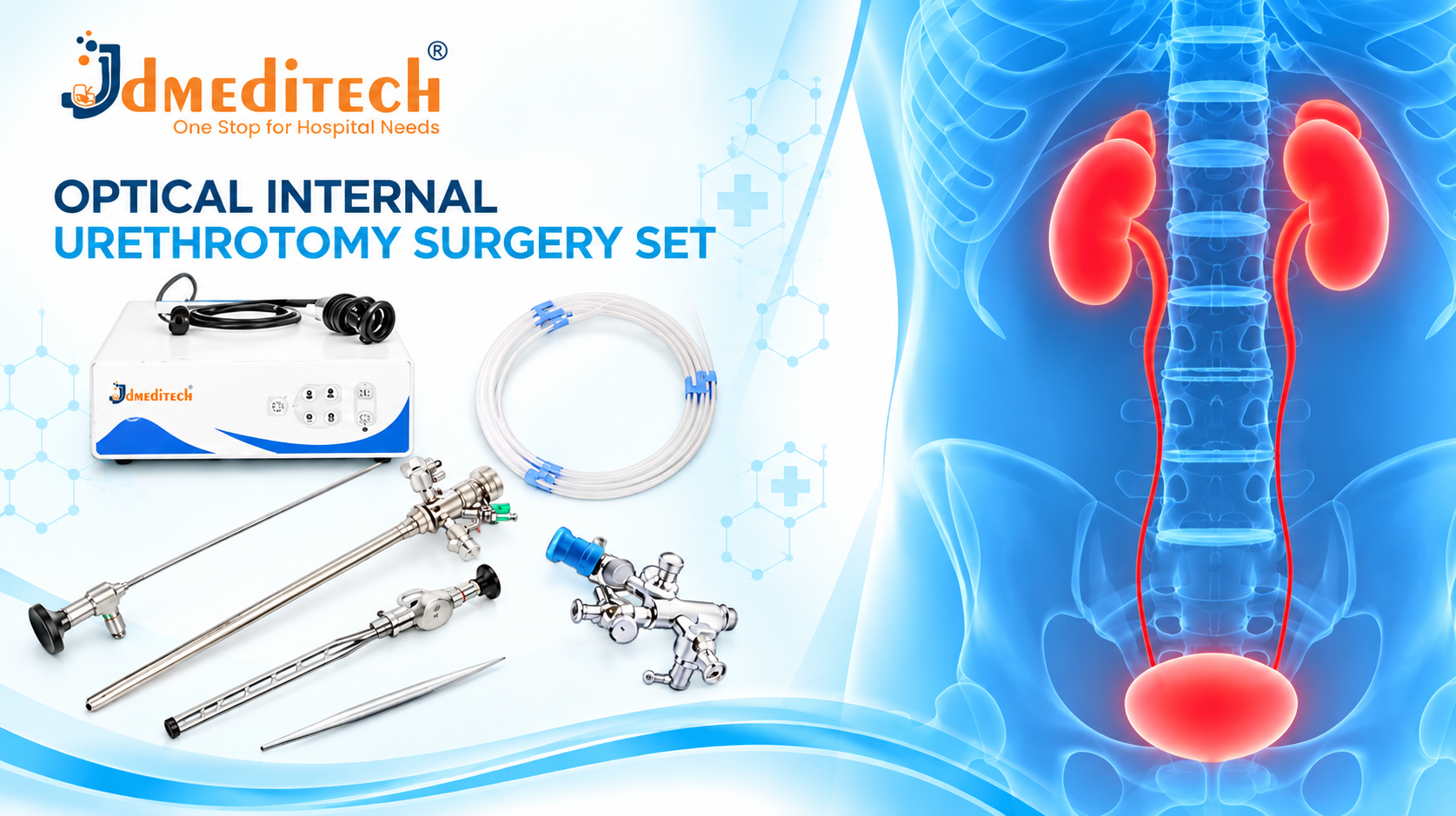
Optical Internal Urethrotomy Surgery Set: Instruments, Uses & Benefits
An Optical Internal Urethrotomy Surgery Set includes specialized urology instruments that support selected endoscopic procedures for urethral stricture treatment. Medical professionals also call this procedure direct vision internal urethrotomy, or DVIU.
During the procedure, a urologist uses an optical urethrotome to examine a narrowed section of the urethra. The surgeon then uses a compatible cutting instrument to incise the selected stricture under direct vision.
Moreover, JDMeditech offers urology instruments and accessories for hospitals, surgical centers, and medical distributors. This guide explains the common instruments, features, applications, and important selection factors associated with optical internal urethrotomy equipment.
What Is an Optical Internal Urethrotomy Surgery Set?
An Optical Internal Urethrotomy Surgery Set contains compatible endoscopic instruments that help surgeons perform selected internal urethrotomy procedures.
A urethral stricture develops when scar tissue narrows the urethra. Consequently, this narrowing may interfere with normal urine flow and cause urinary symptoms.
Optical internal urethrotomy uses an endoscopic approach to make an incision in selected strictures. However, this treatment does not suit every type of urethral narrowing.
For example, clinical guidelines support considering DVIU for selected primary, single, short, non-obliterative bulbar urethral strictures. Therefore, careful patient selection remains important.
Common Instruments Used in an Optical Internal Urethrotomy Set
Different urethrotomy systems require different instruments. Therefore, hospitals should review the complete equipment configuration before selecting a set.
1. Optical Urethrotome
An optical urethrotome helps surgeons visualize the urethra during internal urethrotomy. Moreover, its optical system supports examination of the narrowed urethral segment.
During treatment, the surgeon uses a compatible cutting mechanism under direct vision. As a result, the instrument supports endoscopic management of selected strictures.
2. Urethrotomy Sheath
A compatible urethrotomy sheath provides an access channel for the optical instrument and selected accessories.
In addition, its diameter and design must match the selected urethrotome system. Therefore, hospitals should verify compatibility before purchasing.
3. Telescope
A compatible rigid telescope allows the surgeon to examine the urethral passage during the procedure.
Furthermore, different optical systems may require specific telescope dimensions and viewing angles. Consequently, the purchasing team should confirm these details.
4. Urethrotomy Knife
Surgeons use a compatible cold-knife urethrotomy instrument to incise selected urethral strictures under direct visualization.
However, different urethrotome systems may require different knife designs. Therefore, users should verify the knife configuration before use.
5. Working Element
A compatible working element supports controlled movement of the cutting instrument within the urethrotomy system.
Moreover, the working element must match the selected optical equipment. Therefore, hospitals should confirm mechanical compatibility before ordering replacement instruments.
6. Urology Guide Wire
A suitable guide wire may help surgeons maintain access during selected urethral procedures.
However, the clinical situation and surgical technique determine whether the surgeon needs a guide wire. In addition, the selected wire must match the intended application.
7. Light Source and Light Cable
A compatible light source and light cable provide illumination for the optical endoscopic system.
As a result, the surgeon can examine the urethral passage under suitable lighting conditions. Furthermore, proper connections support equipment compatibility.
8. Irrigation Accessories
Irrigation accessories may help maintain visibility during optical urethrotomy.
Moreover, the surgical team should select an appropriate irrigation arrangement for the endoscopic system. Therefore, equipment compatibility remains essential.
9. Camera System
A compatible camera system displays endoscopic images on a monitor.
In addition, selected systems may support image recording and procedural documentation. Consequently, healthcare facilities should review their visualization requirements.
10. Urinary Catheter
Healthcare professionals may use a urinary catheter after selected internal urethrotomy procedures.
However, the patient’s condition and surgical findings determine the need for catheterization. Furthermore, the treating clinician decides the appropriate duration.
Optical Internal Urethrotomy Set Components and Functions
The following table explains the common instruments and their functions. However, the actual components depend on the selected equipment configuration.
| Instrument | Primary Function |
|---|---|
| Optical Urethrotome | Supports direct-vision internal urethrotomy |
| Urethrotomy Sheath | Provides access for compatible instruments |
| Telescope | Supports visualization of the urethra |
| Urethrotomy Knife | Incises selected urethral strictures |
| Working Element | Supports controlled cutting-instrument movement |
| Guide Wire | Supports access when clinically indicated |
| Light Source and Cable | Provide endoscopic illumination |
| Irrigation Accessories | Support visibility during examination |
| Camera System | Displays compatible endoscopic images |
| Urinary Catheter | Supports postoperative drainage when indicated |
These instruments commonly support optical urethrotomy procedures. Nevertheless, customers should confirm the actual JDMeditech set contents against the product catalogue.
Key Features of an Optical Internal Urethrotomy Surgery Set
An Optical Internal Urethrotomy Surgery Set supports selected endoscopic procedures through compatible instruments. In addition, its optical components help surgeons examine the urethral passage.
1. Direct Endoscopic Visualization
An optical urethrotome allows the surgeon to view the urethral narrowing during the procedure.
Moreover, the optical system supports direct observation of the treatment area. As a result, the surgeon can guide the compatible cutting instrument.
2. Transurethral Access
Surgeons perform optical internal urethrotomy through the natural urinary passage.
Therefore, the standard procedure does not require an external surgical incision. However, the procedure still requires appropriate clinical preparation.
3. Compatible Cutting Instruments
Cold-knife urethrotomy uses a compatible mechanical cutting instrument.
In addition, other endoscopic incision technologies may offer different treatment options. However, their equipment requirements and clinical applications may differ.
4. Optical System Compatibility
The telescope, sheath, working element, and cutting instrument must work together as a compatible system.
Therefore, hospitals should evaluate the complete equipment configuration. Moreover, compatibility checks help identify the correct replacement components.
5. Configurable Instrument Selection
Hospitals may select instruments according to their clinical requirements and existing endoscopy equipment.
Furthermore, purchasing teams should review the manufacturer’s documentation. As a result, they can confirm whether the selected components match the intended application.
Applications of an Optical Internal Urethrotomy Surgery Set
An Optical Internal Urethrotomy Surgery Set primarily supports endoscopic management of selected urethral strictures.
For example, surgeons may consider the procedure for suitable short bulbar strictures. However, patient selection depends on clinical assessment.
- Selected short bulbar urethral strictures
- Selected primary non-obliterative urethral strictures
- Direct endoscopic visualization of urethral narrowing
- Cold-knife internal urethrotomy using compatible instruments
- Selected recurrent strictures when clinically appropriate
Importantly, DVIU does not provide a suitable treatment for every urethral stricture. For example, long, complex, penile, or repeatedly recurrent strictures may require other approaches.
Therefore, a qualified urologist should evaluate the stricture before recommending treatment.
How Is Optical Internal Urethrotomy Performed?
Trained urologists perform optical internal urethrotomy in an appropriate clinical setting.
First, the healthcare team reviews the patient’s symptoms, medical history, and urethral anatomy.
Next, the surgeon introduces a compatible optical urethrotome through the urethra.
Afterward, the surgeon identifies the narrowed section using direct endoscopic visualization.
Then, the surgeon uses an appropriate cutting instrument to incise the selected stricture.
Following the procedure, the clinical team evaluates the result and decides whether the patient needs temporary urinary catheterization.
Finally, follow-up assessments help clinicians monitor urinary symptoms and possible stricture recurrence.
However, the exact technique and postoperative management depend on the patient’s condition.
Benefits of Optical Internal Urethrotomy
Optical internal urethrotomy offers an endoscopic treatment option for selected urethral strictures. Moreover, the procedure combines direct visualization with compatible cutting instruments.
1. Endoscopic Treatment Approach
Surgeons perform DVIU through the natural urinary passage.
As a result, standard internal urethrotomy avoids an external incision. However, patients still require appropriate clinical evaluation.
2. Direct Visualization
The optical system allows the surgeon to view the narrowed urethral segment.
Therefore, the surgeon can guide the cutting instrument under direct endoscopic visualization.
3. Treatment Option for Selected Short Strictures
Urologists may consider DVIU for suitable short bulbar urethral strictures.
However, treatment outcomes depend on stricture length, location, previous procedures, and other clinical factors.
4. Compatible Instrument Options
Different urethrotome systems offer various instrument configurations.
Consequently, hospitals can compare equipment according to their clinical requirements. In addition, they should confirm the compatibility of every selected component.
Optical Internal Urethrotomy vs Urethral Dilation
Optical internal urethrotomy and urethral dilation provide different approaches to selected urethral strictures.
While internal urethrotomy uses an endoscopic incision, dilation gradually expands the narrowed segment.
| Feature | Optical Internal Urethrotomy | Urethral Dilation |
|---|---|---|
| Approach | Endoscopic incision | Gradual expansion of narrowing |
| Common Equipment | Optical urethrotome and compatible knife | Suitable dilators or dilation devices |
| Visualization | Direct endoscopic visualization | Depends on dilation technique |
| Clinical Selection | Selected suitable strictures | Selected suitable strictures |
| Recurrence | Possible | Possible |
Both treatments may suit selected patients. Nevertheless, neither approach guarantees permanent freedom from recurrence.
Therefore, the treating urologist should consider the patient’s stricture characteristics and treatment history.
Optical Internal Urethrotomy vs Urethroplasty
Optical internal urethrotomy and urethroplasty offer different treatments for urethral stricture disease.
DVIU uses an endoscopic incision to treat selected narrowing. In contrast, urethroplasty uses reconstructive surgery to repair the affected urethral segment.
Although DVIU may suit selected short strictures, urologists often prefer urethroplasty for longer or recurrent strictures when appropriate.
Therefore, specialists should evaluate the stricture and review current clinical guidelines before selecting treatment.
How to Choose the Right Optical Internal Urethrotomy Set
Hospitals and medical distributors should review the complete equipment configuration before purchasing an Optical Internal Urethrotomy Surgery Set.
First, identify the required optical urethrotome system. Next, confirm the dimensions and compatibility of the selected instruments.
Important Selection Factors
- Optical urethrotome model
- Urethrotomy sheath diameter
- Telescope diameter and viewing angle
- Working element compatibility
- Urethrotomy knife design
- Guide wire compatibility
- Light source and cable connections
- Camera system compatibility
- Irrigation accessory requirements
- Reusable or single-use classification
- Approved cleaning and sterilization instructions
- Manufacturer documentation
Furthermore, purchasing teams should verify the actual supplied components and their approved intended uses.
As a result, hospitals can select equipment that matches their clinical and operational requirements.
Safety and Maintenance Considerations
Optical internal urethrotomy requires appropriate patient selection, suitable equipment, and trained surgical personnel.
Before the procedure, the clinical team should assess infection risk and review relevant diagnostic findings.
Moreover, healthcare professionals must clean and sterilize reusable instruments according to validated manufacturer instructions.
Potential complications include bleeding, urinary tract infection, urethral injury, and stricture recurrence.
Furthermore, repeated endoscopic treatment may not suit some patients with recurrent or complex strictures.
Therefore, the healthcare team should arrange appropriate clinical follow-up after treatment.
Optical Internal Urethrotomy Surgery Set by JDMeditech
JDMeditech offers urology surgical instruments and accessories for hospitals, surgical centers, and international medical distributors.
Our urology product range includes selected optical urethrotomy instruments, endoscopic accessories, and related medical equipment.
Moreover, customers can contact our team to request available configurations, technical specifications, and quotations.
For more information about the Optical Internal Urethrotomy Surgery Set, visit www.jdmeditech.com.
Frequently Asked Questions About Optical Internal Urethrotomy Sets
1. What is an Optical Internal Urethrotomy Surgery Set?
An Optical Internal Urethrotomy Surgery Set contains compatible endoscopic instruments that support selected direct vision internal urethrotomy procedures.
2. What does OIU stand for?
OIU stands for Optical Internal Urethrotomy. In addition, medical professionals commonly use the abbreviation DVIU for direct vision internal urethrotomy.
3. What does DVIU stand for?
DVIU stands for Direct Vision Internal Urethrotomy. During this procedure, a urologist uses an optical instrument to examine and treat selected urethral strictures.
4. What is an optical urethrotome used for?
Urologists use an optical urethrotome to visualize the urethra and perform selected internal urethrotomy procedures.
5. Which instruments are commonly used during OIU?
Common instruments include an optical urethrotome, compatible sheath, telescope, working element, cutting knife, and illumination accessories.
6. Is optical internal urethrotomy suitable for every urethral stricture?
No. Urologists generally consider DVIU for selected short, non-obliterative strictures, particularly in the bulbar urethra. However, other strictures may require different treatment approaches.
7. Can a urethral stricture return after OIU?
Yes. A urethral stricture can recur after treatment. Moreover, the risk depends on stricture characteristics, previous procedures, and other clinical factors.
8. What is the difference between OIU and urethroplasty?
OIU uses an endoscopic incision to treat selected strictures. In contrast, urethroplasty uses reconstructive surgery to repair the narrowed urethra.
9. Where can I inquire about JDMeditech OIU instruments?
Hospitals and distributors can visit JDMeditech for product details, available configurations, and quotations.
Conclusion
An Optical Internal Urethrotomy Surgery Set supports selected endoscopic procedures for urethral stricture management.
Moreover, compatible optical instruments allow surgeons to visualize and incise suitable urethral narrowing.
Therefore, selecting the correct equipment configuration and appropriate clinical indications remains important.
Contact JDMeditech for optical urethrotomy instruments, urology accessories, and international medical device inquiries.
Medical Disclaimer: This article provides general educational information. Qualified healthcare professionals must select suitable medical procedures and devices according to clinical judgment and approved manufacturer instructions.




