



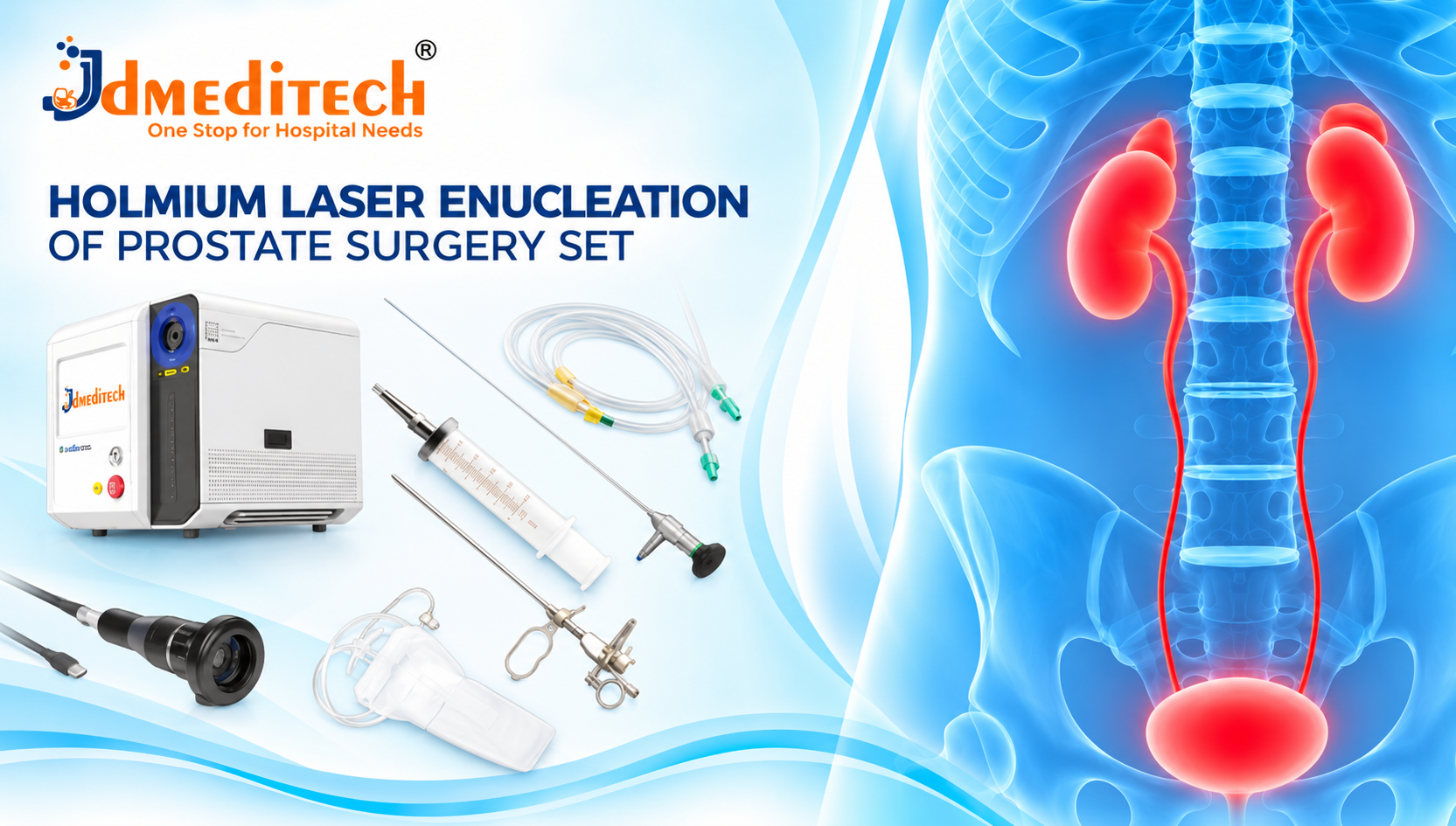
Holmium Laser Enucleation of Prostate Surgery Set: Instruments, Uses & Benefits
A Holmium Laser Enucleation of Prostate Surgery Set includes specialized urology instruments for endoscopic prostate procedures. Urologists use Holmium Laser Enucleation of the Prostate (HoLEP) to treat selected patients with urinary obstruction caused by benign prostatic hyperplasia (BPH).
During HoLEP, a surgeon uses holmium laser energy to separate enlarged prostate tissue from the surgical capsule. Afterward, compatible equipment helps remove the tissue from the bladder.
In addition, JDMeditech offers urology instruments and accessories for hospitals, surgical centers, and medical distributors. This guide explains the common HoLEP instruments, their applications, and important equipment selection factors.
What Is a Holmium Laser Enucleation of Prostate Surgery Set?
A Holmium Laser Enucleation of Prostate Surgery Set combines compatible endoscopic instruments and laser equipment for selected prostate enucleation procedures.
HoLEP provides a surgical treatment option for urinary obstruction caused by benign prostate enlargement. Moreover, surgeons access the prostate through the natural urinary passage.
Therefore, standard HoLEP does not require an external incision. However, the procedure requires trained personnel, suitable equipment, and appropriate patient selection.
Understanding Holmium Laser Technology
A holmium laser system uses holmium:yttrium-aluminium-garnet (Ho:YAG) laser technology. In addition, the generator delivers laser energy through a compatible optical fiber.
During HoLEP, surgeons use this energy to separate obstructing prostate tissue. Furthermore, the laser supports bleeding control during suitable procedures.
The Ho:YAG laser typically operates at a wavelength of approximately 2,140 nanometers. Consequently, its interaction with water-containing tissue supports endoscopic cutting and coagulation.
Before use, healthcare facilities must confirm laser generator, fiber, and endoscope compatibility.
Common Instruments Used in a HoLEP Surgery Set
Different HoLEP systems require different equipment configurations. Therefore, hospitals should review the complete instrument list before purchasing.
1. Holmium Laser Generator
The holmium laser generator provides laser energy for compatible prostate enucleation procedures.
Moreover, its available power, pulse settings, and operating features depend on the selected model. Hospitals should therefore review the manufacturer’s technical specifications.
2. Laser Resectoscope
A compatible laser resectoscope provides transurethral access and supports visualization during HoLEP.
In addition, its working channel accommodates suitable laser instruments and accessories.
3. Laser Fiber
A compatible laser fiber transfers energy from the generator to the surgical area.
Furthermore, surgeons use the fiber to separate selected prostate tissue under endoscopic visualization. However, fiber dimensions and operating limits must match the laser system.
4. Resectoscope Sheath
A suitable resectoscope sheath provides an access channel for compatible instruments.
Moreover, selected sheath designs support irrigation during the procedure. Therefore, surgeons must use the correct sheath configuration.
5. Telescope
A compatible telescope provides visualization of the urethra, prostate, and operative field.
As a result, surgeons can guide the laser fiber and monitor tissue separation.
6. Working Element
A compatible working element supports the selected endoscopic instrument arrangement.
In addition, its design must match the sheath, telescope, and laser fiber system.
7. Tissue Morcellator
A tissue morcellator helps surgeons fragment and remove enucleated prostate tissue from the bladder.
Moreover, suitable morcellation equipment plays an important role in many HoLEP procedures. However, the morcellator may form part of a separate equipment configuration.
8. Irrigation Accessories
Irrigation accessories support endoscopic visibility and fluid management.
Furthermore, the surgical team monitors irrigation according to the selected system and clinical requirements.
9. Camera and Light Source
A compatible camera system displays endoscopic images on a monitor. Meanwhile, the light source provides illumination for the operative field.
Together, these systems support visualization during endoscopic surgery.
10. Urinary Catheter
Healthcare professionals commonly use a urinary catheter after HoLEP to support postoperative bladder drainage.
However, the treating clinician determines the catheter type and duration according to the patient’s condition.
HoLEP Surgery Set Components and Functions
The following table explains common HoLEP equipment and its functions. However, the actual supplied instruments depend on the selected configuration.
| Instrument | Primary Function |
|---|---|
| Holmium Laser Generator | Provides laser energy for prostate enucleation |
| Laser Resectoscope | Supports transurethral access and visualization |
| Laser Fiber | Delivers laser energy to prostate tissue |
| Resectoscope Sheath | Provides access for compatible instruments |
| Telescope | Supports direct endoscopic visualization |
| Working Element | Supports compatible instrument operation |
| Tissue Morcellator | Fragments and removes enucleated tissue |
| Irrigation Accessories | Support visibility and fluid management |
| Camera and Light Source | Provide imaging and illumination |
| Urinary Catheter | Supports postoperative drainage |
Importantly, these instruments represent common HoLEP equipment. Therefore, customers should confirm the actual JDMeditech packing list before ordering.
Key Features of a Holmium Laser Enucleation of Prostate Surgery Set
1. Endoscopic Surgical Access
HoLEP uses the natural urinary passage to access the prostate.
Therefore, surgeons can treat selected prostate enlargement without making an external incision.
2. Holmium Laser Technology
The Ho:YAG laser supports tissue separation and coagulation during compatible procedures.
Moreover, surgeons can select suitable operating settings according to device instructions and clinical requirements.
3. Direct Visualization
A compatible endoscopic system allows surgeons to examine the operative field.
As a result, they can guide the laser fiber while separating obstructing tissue.
4. Tissue Removal Capability
HoLEP commonly combines laser enucleation with tissue morcellation.
After enucleation, surgeons use suitable equipment to remove tissue from the bladder.
5. Compatible Instrument Configurations
Hospitals can select equipment according to their clinical requirements.
However, every component must match its approved intended use and technical specifications.
Applications of a Holmium Laser Enucleation of Prostate Surgery Set
A Holmium Laser Enucleation of Prostate Surgery Set primarily supports endoscopic treatment of benign prostatic obstruction.
For example, urologists may consider HoLEP for suitable patients with moderate to severe urinary symptoms caused by BPH.
- Treatment of selected benign prostatic obstruction
- Management of suitable enlarged prostate conditions
- Endoscopic removal of obstructing prostate tissue
- Treatment of selected patients with urinary retention caused by BPH
- Selected cases requiring surgical relief of bladder outlet obstruction
However, HoLEP does not treat every prostate condition. In particular, it is not a substitute for prostate cancer treatment.
Therefore, a qualified urologist should evaluate each patient before recommending surgery.
How Is HoLEP Surgery Performed?
Trained urologists perform HoLEP in an appropriately equipped surgical setting.
First, the healthcare team reviews the patient’s symptoms, prostate condition, medical history, and relevant investigations.
Next, the surgeon introduces a compatible endoscopic instrument through the urethra.
Afterward, the surgeon uses holmium laser energy to separate obstructing prostate tissue.
Then, suitable morcellation equipment helps remove the enucleated tissue from the bladder.
Following tissue removal, the surgeon evaluates the operative field and checks bleeding control.
Finally, the clinical team arranges appropriate bladder drainage and postoperative monitoring.
However, the exact technique and recovery plan depend on the patient’s condition and surgical findings.
Benefits of Holmium Laser Enucleation of the Prostate
1. Minimally Invasive Approach
HoLEP uses transurethral access rather than an external incision.
As a result, it offers an established endoscopic surgical option for suitable patients.
2. Effective Relief of Obstruction
HoLEP removes selected obstructing prostate tissue.
Consequently, suitable patients may experience improved urinary flow and reduced urinary symptoms after recovery.
3. Treatment Across Different Prostate Sizes
Urologists can consider HoLEP for a range of prostate sizes.
However, patient suitability also depends on anatomy, symptoms, medical history, and surgeon expertise.
4. Bleeding Control
Holmium laser energy supports tissue coagulation during enucleation.
Moreover, clinical studies have reported lower blood loss and fewer transfusions in some comparisons with traditional TURP.
5. Established Long-Term Outcomes
Clinical evidence supports HoLEP as an effective treatment for benign prostatic obstruction.
Furthermore, studies have demonstrated durable improvements in urinary symptoms and flow rates.
Nevertheless, individual outcomes vary, and complications or repeat procedures remain possible.
HoLEP vs TURP: What Is the Difference?
HoLEP and transurethral resection of the prostate (TURP) both treat selected urinary obstruction caused by BPH.
However, they use different methods to remove obstructing tissue.
| Feature | HoLEP | TURP |
|---|---|---|
| Full Form | Holmium Laser Enucleation of the Prostate | Transurethral Resection of the Prostate |
| Energy Source | Holmium laser | Electrosurgical energy |
| Tissue Removal | Laser enucleation followed by tissue removal | Endoscopic tissue resection |
| Access | Through the urethra | Through the urethra |
| Common Instruments | Laser endoscope, fiber, and morcellation equipment | Resectoscope and compatible electrodes |
| Clinical Selection | Depends on patient and surgeon factors | Depends on patient and surgeon factors |
Both procedures have established roles in BPH treatment. Therefore, the urologist should select the most suitable option for each patient.
HoLEP vs Open Simple Prostatectomy
HoLEP and open simple prostatectomy provide different approaches to treating selected large benign prostate enlargement.
HoLEP uses endoscopic access through the urethra. In contrast, open simple prostatectomy requires a surgical incision to remove obstructing prostate tissue.
Moreover, HoLEP often offers shorter hospitalization and catheterization periods in comparative studies.
However, clinical outcomes depend on patient characteristics, surgical expertise, and the treatment setting.
How to Choose the Right HoLEP Surgery Set
Hospitals and medical distributors should evaluate the complete equipment configuration before purchasing a Holmium Laser Enucleation of Prostate Surgery Set.
First, confirm the required laser generator and endoscopic system. Next, review the compatibility of the laser fiber, sheath, and other instruments.
Important Selection Factors
- Holmium laser generator specifications
- Laser power and operating capabilities
- Compatible laser fiber dimensions
- Laser resectoscope configuration
- Resectoscope sheath diameter
- Telescope diameter and viewing angle
- Working element compatibility
- Tissue morcellator availability and compatibility
- Camera and light source connections
- Irrigation system requirements
- Laser safety requirements
- Cleaning and sterilization instructions
- Manufacturer documentation
Furthermore, purchasing teams should confirm the actual supplied accessories and approved intended uses.
As a result, hospitals can select equipment that matches their procedural requirements.
Safety and Maintenance Considerations
HoLEP requires trained surgeons, appropriate patient selection, and suitable laser safety procedures.
Before surgery, the clinical team should review infection risk, bleeding risk, and relevant medical conditions.
Moreover, healthcare professionals must inspect the instruments and follow validated reprocessing instructions.
Potential complications include bleeding, urinary tract infection, temporary urinary leakage, urethral stricture, and bladder neck narrowing.
In addition, patients may experience changes in ejaculation after prostate surgery.
Therefore, healthcare professionals should explain potential risks and arrange appropriate postoperative follow-up.
Holmium Laser Enucleation of Prostate Surgery Set by JDMeditech
JDMeditech offers urology surgical instruments and accessories for hospitals, surgical centers, and international medical distributors.
Our urology product range includes selected holmium laser systems, endoscopic instruments, and related urology accessories.
Moreover, customers can contact our team to request available configurations, technical information, and quotations.
For more information about the Holmium Laser Enucleation of Prostate Surgery Set, visit www.jdmeditech.com.
Frequently Asked Questions About HoLEP Surgery Sets
1. What is a Holmium Laser Enucleation of Prostate Surgery Set?
For HoLEP procedures, surgeons use compatible endoscopic instruments and holmium laser equipment. Together, these devices support selected prostate enucleation procedures.
2. What does HoLEP stand for?
HoLEP stands for Holmium Laser Enucleation of the Prostate. This endoscopic procedure helps treat selected patients with benign prostatic obstruction.
3. What is HoLEP surgery used for?
Urologists perform HoLEP to relieve urinary obstruction caused by benign prostate enlargement. As a result, suitable patients may experience improved urinary flow.
4. Which instruments are commonly used during HoLEP?
Common equipment includes a holmium laser generator, laser fiber, compatible endoscope, irrigation accessories, and tissue morcellation equipment. However, the exact configuration varies.
5. Does HoLEP require an external incision?
No. Standard HoLEP uses transurethral access. Therefore, the surgeon does not need an external incision.
6. What is the difference between HoLEP and TURP?
HoLEP uses laser energy to enucleate obstructing prostate tissue. In contrast, TURP uses electrosurgical instruments to resect tissue.
7. Is HoLEP suitable for every patient with BPH?
No. A urologist must assess the patient’s symptoms, prostate condition, medical history, and treatment options before recommending surgery.
8. Is tissue morcellation necessary during HoLEP?
Standard HoLEP commonly uses tissue morcellation to remove enucleated prostate tissue. However, the exact tissue removal method depends on the surgical technique and equipment.
9. Can urinary symptoms return after HoLEP?
Yes. Although HoLEP offers durable outcomes for many patients, some individuals may experience persistent or recurrent symptoms.
10. Where can I inquire about JDMeditech HoLEP instruments?
Hospitals and distributors can visit JDMeditech for product information, available configurations, and quotations.
Conclusion
A Holmium Laser Enucleation of Prostate Surgery Set supports selected endoscopic procedures for benign prostatic obstruction. In addition, the equipment provides compatible instruments for prostate enucleation.
Moreover, holmium laser technology allows surgeons to separate obstructing prostate tissue. Afterward, suitable equipment helps remove the enucleated tissue.
Therefore, hospitals should carefully review instrument compatibility, technical specifications, and clinical requirements before selecting equipment. Furthermore, they should confirm the complete equipment configuration with the supplier.
Contact JDMeditech for HoLEP surgical instruments, holmium laser systems, and international medical device inquiries.
Medical Disclaimer: This article provides general educational information. Qualified healthcare professionals must select suitable procedures and medical devices according to clinical judgment and approved manufacturer instructions.




