



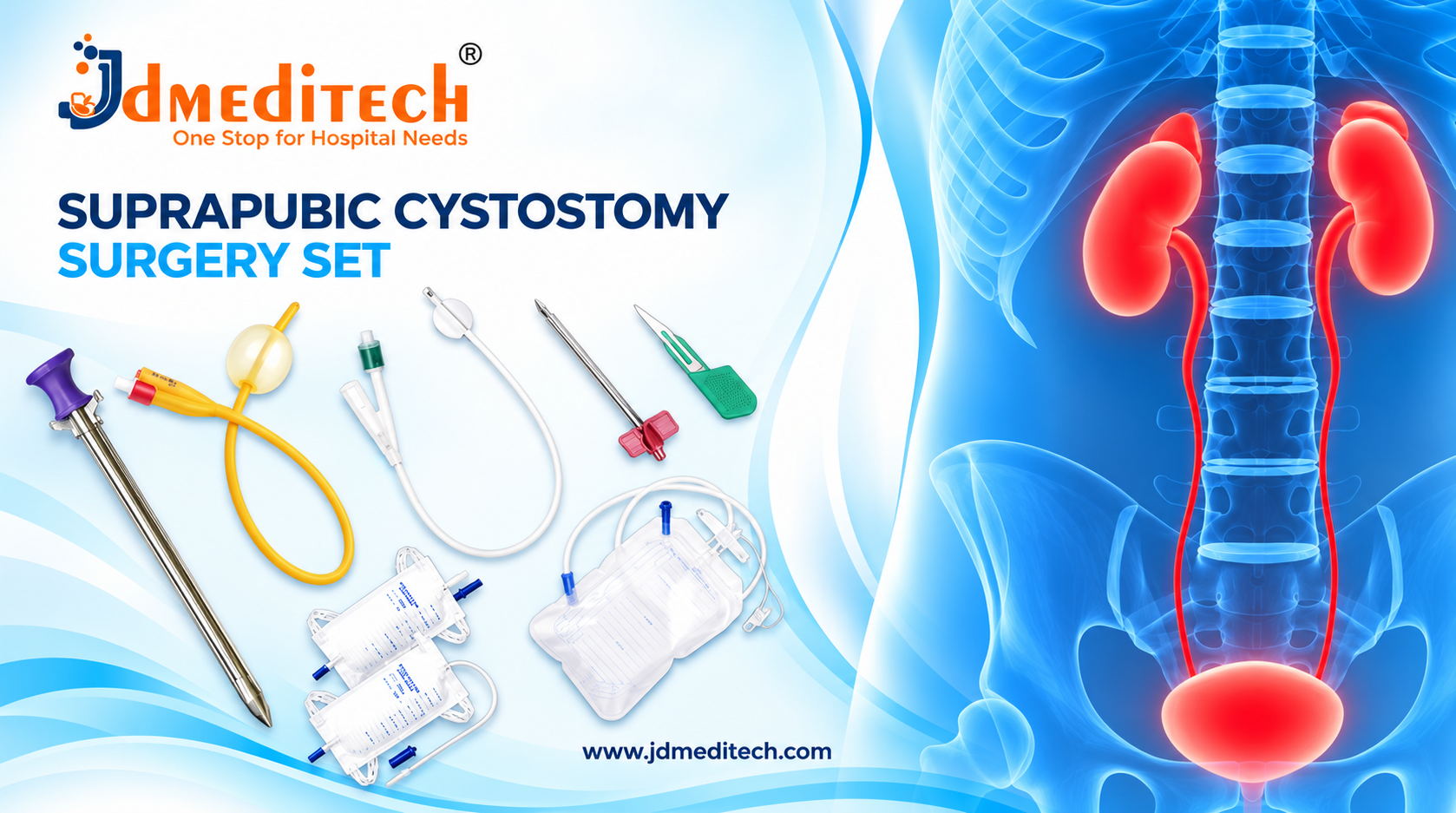
Suprapubic Cystostomy Surgery Set: Instruments, Uses & Benefits
A Suprapubic Cystostomy Surgery Set includes specialized urology instruments and accessories that support suprapubic bladder drainage procedures. Healthcare professionals use suprapubic catheterization when selected patients need urinary drainage through the lower abdominal wall.
During the procedure, a qualified clinician establishes a suitable access route into the bladder. The clinician then places a compatible urinary catheter to support continuous or temporary urine drainage.
Moreover, JDMeditech offers urology instruments and accessories for hospitals, surgical centers, and international medical distributors. This guide explains common suprapubic cystostomy instruments, applications, benefits, and important equipment selection factors.
What Is a Suprapubic Cystostomy Surgery Set?
A Suprapubic Cystostomy Surgery Set contains compatible medical instruments that support selected suprapubic catheter placement procedures.
Suprapubic cystostomy creates a drainage route between the urinary bladder and the lower abdominal wall. As a result, urine can drain through a catheter without passing through the urethra.
In addition, clinicians may consider suprapubic drainage when urethral catheterization is unsuitable, unsuccessful, or undesirable for a particular patient.
However, the exact procedure and equipment configuration depend on the patient’s condition and clinical requirements.
Understanding Suprapubic Catheterization
Suprapubic catheterization provides an alternative route for bladder drainage. Unlike a urethral catheter, a suprapubic catheter enters the bladder through the lower abdominal wall.
For example, clinicians may consider this approach for selected patients with urinary retention, urethral injury concerns, or long-term catheterization requirements.
Furthermore, suprapubic drainage may help avoid repeated urethral instrumentation in suitable patients.
Nevertheless, clinicians must assess bladder anatomy, infection risk, bleeding risk, and other factors before selecting the procedure.
Common Instruments Used in a Suprapubic Cystostomy Surgery Set
Different suprapubic catheter systems require different components. Therefore, hospitals should confirm the complete instrument configuration before purchasing.
1. Suprapubic Catheter
A suprapubic catheter provides a drainage channel from the bladder to an external collection system.
Moreover, clinicians select the catheter size and design according to the patient’s requirements and the approved device instructions.
2. Cystostomy Trocar
A compatible cystostomy trocar may support bladder access during selected suprapubic catheter placement techniques.
However, trocar-based access requires careful patient selection and appropriate clinical expertise.
3. Puncture Needle
Selected suprapubic catheter kits include a puncture needle for establishing initial access.
In addition, some catheter placement techniques use a guide wire after the clinician confirms appropriate access.
4. Guide Wire
A compatible guide wire may support selected wire-guided suprapubic catheter placement techniques.
However, not every suprapubic catheter system requires a guide wire. Therefore, clinicians should follow the instructions for the selected device.
5. Dilator
Some catheter placement systems include a compatible dilator to prepare the access tract.
Furthermore, the required dimensions depend on the selected catheter and insertion system.
6. Introducer Sheath
A compatible introducer sheath may support catheter placement in selected suprapubic access systems.
Consequently, healthcare facilities should confirm sheath compatibility before using the equipment.
7. Retention Balloon
Some suprapubic catheters include a retention balloon that helps maintain catheter position within the bladder.
However, retention mechanisms differ between catheter designs. Therefore, clinicians must follow the manufacturer’s instructions.
8. Drainage Tubing
Compatible drainage tubing connects the catheter to a suitable urine collection system.
Moreover, secure connections help maintain a functional drainage pathway.
9. Urine Collection Bag
A urine collection bag collects urine from the drainage catheter.
In addition, appropriate positioning and handling help maintain effective drainage.
10. Catheter Accessories
Selected kits may include connectors, clamps, or other accessories for catheter management.
However, the actual accessories depend on the product configuration.
Suprapubic Cystostomy Surgery Set Components and Functions
The following table explains common components and their functions. Nevertheless, the actual supplied instruments depend on the selected kit.
| Instrument | Primary Function |
|---|---|
| Suprapubic Catheter | Provides bladder drainage through the abdominal wall |
| Cystostomy Trocar | Supports selected bladder access techniques |
| Puncture Needle | Supports initial access in suitable systems |
| Guide Wire | Supports selected wire-guided catheter placement |
| Dilator | Helps prepare the access tract when required |
| Introducer Sheath | Supports compatible catheter insertion techniques |
| Retention Balloon | Helps retain compatible catheters in position |
| Drainage Tubing | Connects the catheter to the collection system |
| Urine Collection Bag | Collects urine from the drainage catheter |
| Catheter Accessories | Support selected catheter management functions |
Importantly, these components represent common suprapubic drainage equipment. Customers should confirm the actual JDMeditech packing list before ordering.
Key Features of a Suprapubic Cystostomy Surgery Set
1. Alternative Bladder Drainage Route
Suprapubic catheterization provides a urinary drainage route through the lower abdominal wall.
As a result, clinicians can avoid urethral catheter placement when the suprapubic approach is appropriate.
2. Compatible Catheter Options
Different suprapubic drainage systems offer various catheter configurations.
Therefore, hospitals can select suitable devices according to clinical requirements and manufacturer specifications.
3. Selected Access Techniques
Healthcare professionals may use different suprapubic access techniques depending on the patient’s condition.
Moreover, some systems support trocar-based access, while others use wire-guided techniques.
4. Urinary Drainage Support
A compatible catheter and collection system provide a pathway for urine drainage.
Furthermore, appropriate catheter management helps support ongoing bladder drainage.
5. Equipment Configuration Options
Hospitals can review different catheter sizes, access devices, and drainage accessories.
However, every component must match the approved intended use and selected clinical technique.
Applications of a Suprapubic Cystostomy Surgery Set
A Suprapubic Cystostomy Surgery Set supports selected urinary drainage procedures.
For example, clinicians may consider suprapubic drainage when urethral catheterization presents difficulties or specific concerns.
- Selected cases of urinary retention
- Patients who cannot undergo suitable urethral catheterization
- Selected urethral injury management situations
- Long-term bladder drainage when clinically appropriate
- Selected postoperative urinary drainage requirements
- Alternative catheterization in suitable clinical circumstances
However, suprapubic catheterization does not suit every patient. Therefore, clinicians must evaluate relevant contraindications and procedural risks.
How Is Suprapubic Cystostomy Performed?
Qualified healthcare professionals perform suprapubic catheter placement in an appropriate clinical setting.
First, the clinical team evaluates the patient’s urinary condition, bladder anatomy, and relevant medical history.
Next, the clinician selects an appropriate access technique and compatible catheter system.
During placement, the healthcare team uses suitable clinical guidance and established safety procedures.
Afterward, the clinician confirms appropriate catheter positioning and urine drainage.
Finally, the healthcare team provides catheter care instructions and arranges follow-up when necessary.
However, the exact technique depends on the patient’s condition and the selected medical device.
Benefits of Suprapubic Catheterization
1. Avoids the Urethral Drainage Route
A suprapubic catheter drains urine through the lower abdominal wall.
Therefore, it offers an alternative when urethral catheterization is unsuitable.
2. Supports Selected Long-Term Drainage Needs
Some patients require urinary drainage for extended periods.
In these situations, clinicians may consider a suprapubic catheter according to the patient’s needs and treatment plan.
3. Alternative for Selected Urethral Conditions
Suprapubic catheterization may provide a suitable option for selected patients with urethral problems.
However, the treating clinician must evaluate the condition before recommending the procedure.
4. Catheter Management Options
Compatible suprapubic catheter systems offer different retention and drainage configurations.
Consequently, healthcare teams can select appropriate equipment according to clinical requirements.
Suprapubic Catheter vs Urethral Catheter
Suprapubic and urethral catheters both provide bladder drainage. However, they use different access routes.
| Feature | Suprapubic Catheter | Urethral Catheter |
|---|---|---|
| Access Route | Through the lower abdominal wall | Through the urethra |
| Primary Function | Bladder drainage | Bladder drainage |
| Placement | Requires creation of a suprapubic tract | Uses the natural urinary passage |
| Typical Selection | Selected alternative or long-term drainage situations | Common short-term or long-term drainage situations |
| Potential Complications | Infection, bleeding, bowel injury, blockage | Infection, urethral injury, blockage |
Both catheter types have important clinical applications. Therefore, healthcare professionals should select the most appropriate option for each patient.
Suprapubic Cystostomy vs Urethral Catheterization
Suprapubic cystostomy creates a catheter drainage route through the lower abdomen. In contrast, urethral catheterization introduces a catheter through the urethra.
Moreover, suprapubic access may reduce certain urethral complications in selected long-term catheter users.
However, suprapubic placement carries its own procedural risks. Consequently, clinical assessment remains essential.
How to Choose the Right Suprapubic Cystostomy Surgery Set
Hospitals and medical distributors should review the complete equipment configuration before purchasing a Suprapubic Cystostomy Surgery Set.
First, confirm the required catheter type and size. Next, review the compatible access instruments and drainage accessories.
Important Selection Factors
- Suprapubic catheter size and material
- Catheter length and design
- Retention mechanism
- Cystostomy trocar configuration
- Puncture needle compatibility
- Guide wire dimensions when applicable
- Dilator and introducer sheath compatibility
- Drainage tubing and connector requirements
- Urine collection system compatibility
- Sterility and single-use classification
- Approved intended use
- Manufacturer documentation
Furthermore, purchasing teams should verify the actual supplied accessories and product specifications.
As a result, hospitals can select equipment that matches their clinical and operational requirements.
Safety and Catheter Care Considerations
Suprapubic catheterization requires appropriate patient selection and trained clinical personnel.
Before placement, clinicians should assess relevant risks, including bleeding, infection, and potential injury to nearby structures.
Moreover, healthcare professionals must follow appropriate aseptic techniques and manufacturer instructions.
Potential complications include catheter blockage, urinary tract infection, bleeding, leakage, and injury to surrounding organs.
In addition, patients and caregivers should receive suitable catheter care instructions.
Therefore, appropriate monitoring and clinical follow-up remain important.
Suprapubic Cystostomy Surgery Set by JDMeditech
JDMeditech offers urology instruments and accessories for hospitals, surgical centers, and international medical distributors.
Our urology product range includes selected suprapubic catheters, cystostomy instruments, and related urinary drainage accessories.
Moreover, customers can contact our team to request available configurations, technical specifications, and quotations.
For more information about the Suprapubic Cystostomy Surgery Set, visit www.jdmeditech.com.
Frequently Asked Questions About Suprapubic Cystostomy Sets
1. What is a Suprapubic Cystostomy Surgery Set?
A Suprapubic Cystostomy Surgery Set includes compatible instruments and accessories that support selected suprapubic catheter placement procedures.
2. What is suprapubic catheterization?
Suprapubic catheterization provides bladder drainage through a catheter that enters the bladder via the lower abdominal wall.
3. What is a suprapubic catheter used for?
Clinicians use suprapubic catheters for selected urinary drainage requirements. For example, they may consider this approach when urethral catheterization is unsuitable.
4. Which instruments are commonly included in a suprapubic catheter kit?
Depending on the system, common components may include a catheter, trocar or puncture needle, guide wire, dilator, introducer, and drainage accessories.
5. Is suprapubic catheterization suitable for every patient?
No. Clinicians must assess the patient’s anatomy, medical condition, and relevant procedural risks before selecting this approach.
6. What is the difference between a suprapubic and urethral catheter?
A suprapubic catheter enters the bladder through the lower abdomen. In contrast, a urethral catheter passes through the urethra.
7. Can a suprapubic catheter support long-term drainage?
Yes. Clinicians may recommend suprapubic catheterization for selected patients who require long-term urinary drainage.
8. What complications can occur with suprapubic catheterization?
Possible complications include infection, bleeding, catheter blockage, leakage, and injury to nearby structures. Therefore, appropriate clinical care remains essential.
9. Does every suprapubic catheter kit include a trocar?
No. Different systems use different access techniques and components. Therefore, customers should verify the supplied kit configuration.
10. Where can I inquire about JDMeditech suprapubic cystostomy equipment?
Hospitals and distributors can visit JDMeditech for product details, available configurations, and quotations.
Conclusion
A Suprapubic Cystostomy Surgery Set supports selected urinary drainage procedures through the lower abdominal wall.
Moreover, compatible catheters and access instruments help healthcare professionals establish an alternative drainage route when clinically appropriate.
Therefore, hospitals should carefully review catheter compatibility, technical specifications, and clinical requirements before selecting equipment.
Contact JDMeditech for suprapubic cystostomy instruments, urinary drainage accessories, and international medical device inquiries.
Medical Disclaimer: This article provides general educational information. Qualified healthcare professionals must select suitable procedures and medical devices according to clinical judgment and approved manufacturer instructions.




